Overqualified, Underqualified, or Just Misaligned? How to Diagnose Why You're Getting Filtered Out
October 14, 2026 · 4 min read · Past the Bots
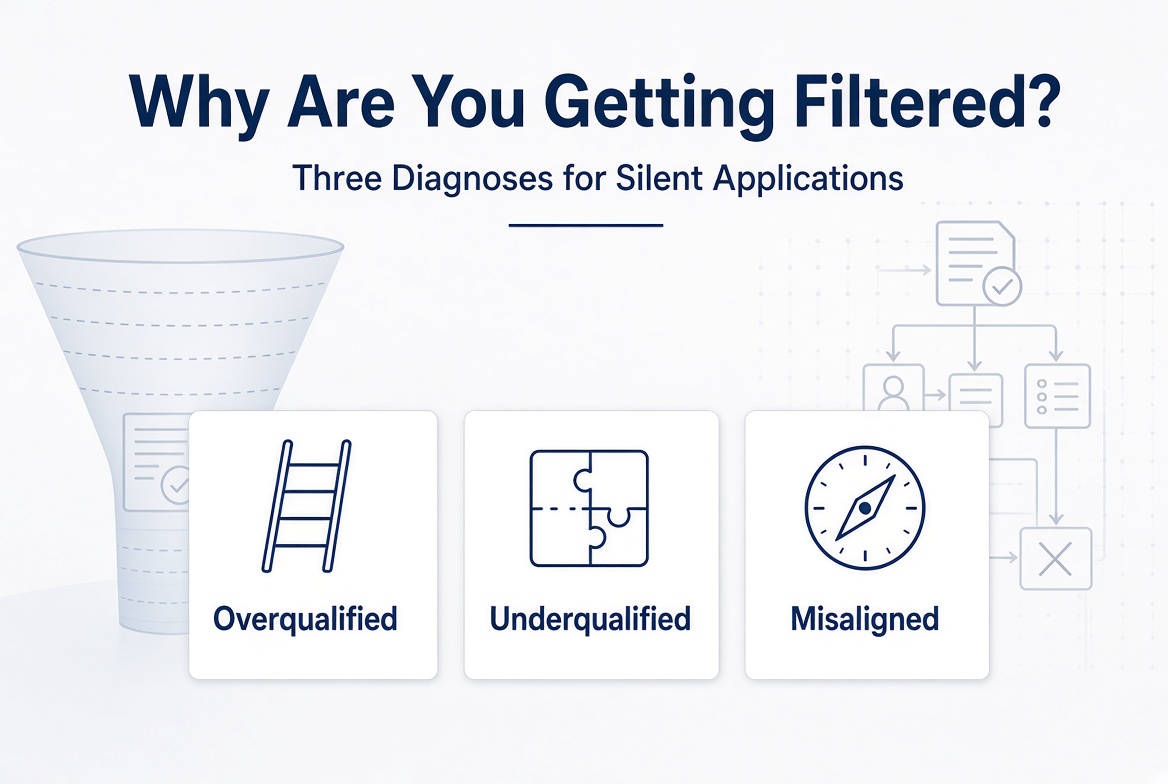 You've sent out dozens of applications. Maybe hundreds. The silence is deafening. Before you spiral into "nobody wants me" territory, stop and ask a more useful question: why are you getting filtered?
There are really only three diagnoses, and each one has a different fix.
Diagnosis 1: You Look Overqualified
This one trips people up because it feels backwards. How can being too experienced hurt you?
A few ways, actually:
- Your title history signals a pay mismatch. If your last three titles were Director, VP, and SVP, and you're applying to a Senior Manager role, the ATS flags you as a potential mismatch before a human ever looks.
- Your years of experience far exceed the posting. A job asking for 3-5 years that gets a 22-year resume often gets auto-deprioritized, or a recruiter assumes you'll bolt the moment something better comes along.
- Your bullets emphasize scale that doesn't fit. Phrases like "managed a $40M budget" or "led a team of 60" can feel intimidating on a role that needs an individual contributor.
The fix: You may not need to hide experience, but you do need to reframe it. Lead with the work itself, not just the scope. If you genuinely want a step-back role, say so briefly in a summary. Cut or condense earlier roles that are no longer relevant. And reconsider whether the target roles are actually right for where you want to go.
Diagnosis 2: You Look Underqualified
This is the more common fear, and it's often fixable without lying or inflating anything.
The real culprit is usually a skills gap on paper that doesn't reflect your actual capabilities. You might have done the work, just under a different name or in a different context.
For example:
- You managed projects but never held the title "Project Manager" and never used the word "Agile" on your resume
- You analyzed data and built reports but described it as "compiled weekly metrics" instead of "built dashboards" or "conducted data analysis"
- You have relevant certifications or coursework that never made it onto the page
The fix: Run your resume against the specific job description you're targeting. A keyword match tool (Past the Bots does this and separates matched from missing skills) will show you exactly what language is absent. Then go back through your real experience and find honest, accurate ways to incorporate those terms. You're not fabricating anything. You're translating.
Diagnosis 3: You're Just Misaligned (and That's a Strategy Problem, Not a Resume Problem)
Sometimes the resume is actually fine. The real issue is that you're applying to jobs that don't match your background in ways that no amount of rewriting will fix.
Signs this might be you:
- You're applying across multiple industries or functions simultaneously with one generic resume
- The roles you want require a specific credential, license, or technology stack you don't have
- Your experience is genuinely niche and the market for it is thin in your geography or salary range
The fix here is mostly about targeting, not writing. Consider:
- Narrowing your focus to roles where you're a 70-80% match, not a stretch
- Creating two or three tailored versions of your resume for different tracks
- Being realistic about whether a pivot requires a stepping-stone role first
- Expanding your geography or remote openness if the local market is saturated
How to Actually Figure Out Which One You Are
Honestly diagnosing the problem requires looking at real data, not gut feelings.
A few things that help:
- Track your application outcomes in a spreadsheet. Note the role level, years of experience required, industry, and whether you got a response. Patterns will emerge.
- Look at where in the funnel you're dropping. No responses at all usually means an ATS or keyword issue. Phone screens that don't convert to interviews often points to something else.
- Get a second set of eyes. A recruiter, career coach, or even a trusted colleague in your field can tell you quickly if your resume reads as over, under, or misaligned for what you're chasing.
- Check what the ATS actually sees. Formatting issues, garbled skills sections, and missing keywords can make a strong resume invisible. Tools like Past the Bots show you exactly what gets extracted and what gets missed, which takes the guesswork out of it.
The Bottom Line
Getting filtered isn't always a resume problem. Sometimes it's a targeting problem. Sometimes it's both. The important thing is figuring out which before you spend another hour tweaking bullet points that aren't the actual issue.
Diagnose first. Then fix the right thing.