Remote Work Killed the Old Productivity Playbook. Here's What That Means for Your Job Search.
August 11, 2026 · 4 min read · Past the Bots
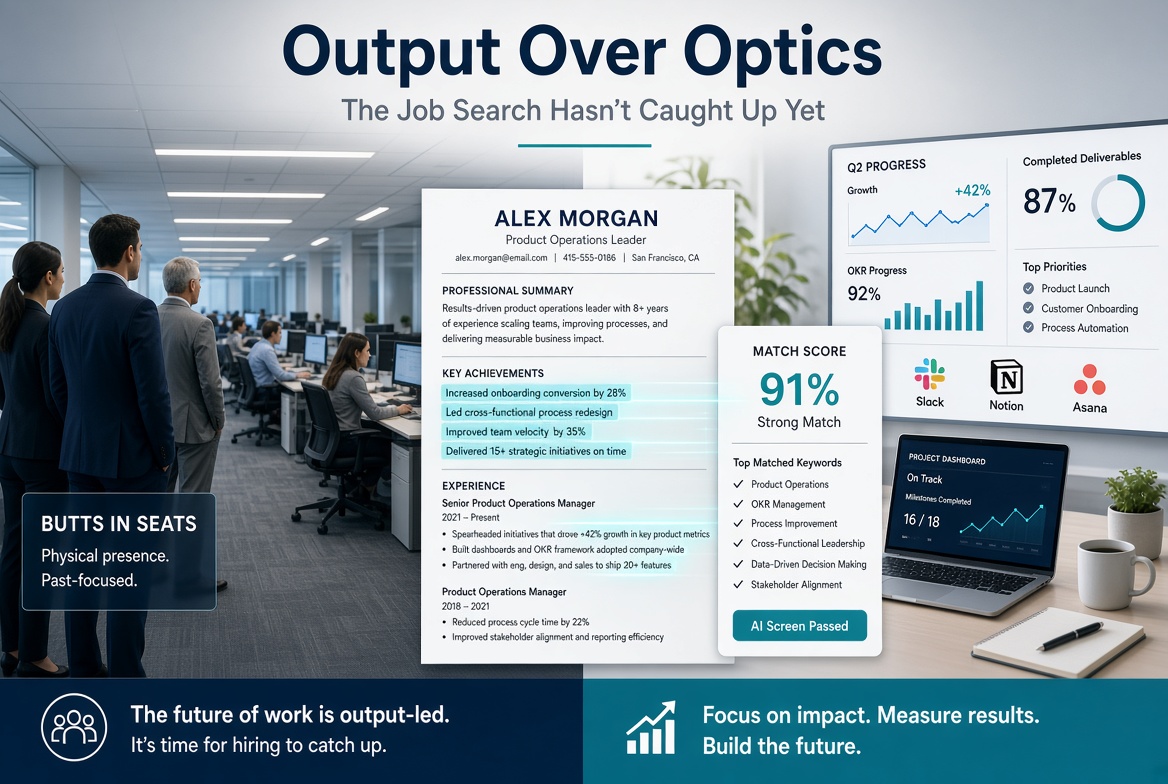 There's a quiet argument happening inside companies right now. On one side: executives who want butts in seats because that's how they've always measured "getting things done." On the other: workers and researchers pointing out that output, not office hours, is what actually matters.
A recent opinion piece making the rounds makes a compelling case that we need entirely new frameworks for measuring productivity at work, ones built around results rather than physical presence. It's a smart argument. But here's the thing nobody in that debate is talking about: the job search hasn't caught up yet either.
While companies figure out how to measure what you do, ATS software is still scanning your resume for what it can recognize. And that gap is costing people interviews.
The Mismatch Nobody Talks About
Remote and hybrid work changed how we actually do our jobs. Deliverables, async communication, self-direction, digital collaboration tools -- these became the real job. But most people's resumes still read like they were written for a 2015 open-plan office.
Think about the skills that matter in a results-driven, remote-forward environment:
- Cross-functional collaboration across time zones
- Project ownership without direct supervision
- Fluency with tools like Notion, Slack, Asana, Jira, or Figma
- Clear written communication (because you can't just walk over and explain yourself)
- Data-driven reporting so stakeholders know what you accomplished
Those skills are valuable. But if your resume buries them in vague phrases like "strong communicator" or "team player," an ATS won't surface them -- and a recruiter sorting through 300 applications won't either.
What ATS Systems Are Actually Looking For
Applicant Tracking Systems don't measure productivity. They match keywords. That sounds cold, but understanding it is genuinely useful.
When a hiring manager posts a job for a remote marketing manager, they're going to include specific terms in that description: tools they use, skills they need, maybe even phrases like "asynchronous communication" or "OKR reporting." The ATS then looks for those exact terms (or close variants) in the resumes it receives.
If your resume says you "kept the team aligned on goals" but the job description says "OKR management," you might be a perfect fit who never gets a callback.
This is where running your resume through an ATS scanner before you apply pays off. Tools like the scan in Past the Bots show you exactly what a system extracts from your resume -- your listed skills, your contact info, your section headers -- and flags where you have gaps against a specific job description. You can paste in the job posting and see a skill-weighted match score that shows which keywords you're hitting, which you're missing, and which gaps might be automatic disqualifiers.
Rewriting for the Results-First Economy
Here's the practical piece. If the workplace is moving toward measuring output over presence, your resume needs to lead with output. That means:
Quantify wherever you can. "Managed social media" becomes "Grew LinkedIn following 40% in six months through a weekly long-form content series." The number shows a result. The detail shows how.
Name the tools. If remote work runs on software, list the software. Don't assume a recruiter or ATS will infer that you know Asana because you said you "managed projects."
Show ownership, not participation. Remote roles often require you to drive things independently. Phrases like "led," "owned," "launched," and "delivered" signal that without you needing to explain your work-from-home setup.
If rewriting bullets sounds daunting, an AI tailoring tool can help you rework your existing experience to match a job description's language -- without making anything up. The goal isn't to fabricate; it's to surface what you actually did in terms the job posting and its ATS will recognize.
The Format Still Has to Work
One more thing the productivity debate misses: even a perfectly written resume can get mangled if it's formatted in a way ATS software can't parse. Columns, text boxes, graphics, and fancy tables all cause problems with automated parsing. A clean, single-column format is still the safest bet for getting your content read correctly before it ever reaches a human.
The Bigger Picture
The argument for measuring productivity differently is the right one. Output matters more than optics. Results matter more than face time. But while that argument plays out in boardrooms and op-ed pages, job seekers are still navigating a screening process built on keyword matching and parse-ability.
The good news: you can work both sides of it. Write a resume that speaks to results and real-world impact. Then make sure the language, formatting, and keywords are positioned to get past the automated layer first.
That's not gaming the system. That's understanding it -- and making sure your actual experience finally gets the credit it deserves.