Should You Chase an AI Startup Job Right Now? A Realistic Look for Young Tech and Consulting Pros
September 30, 2026 · 4 min read · Past the Bots
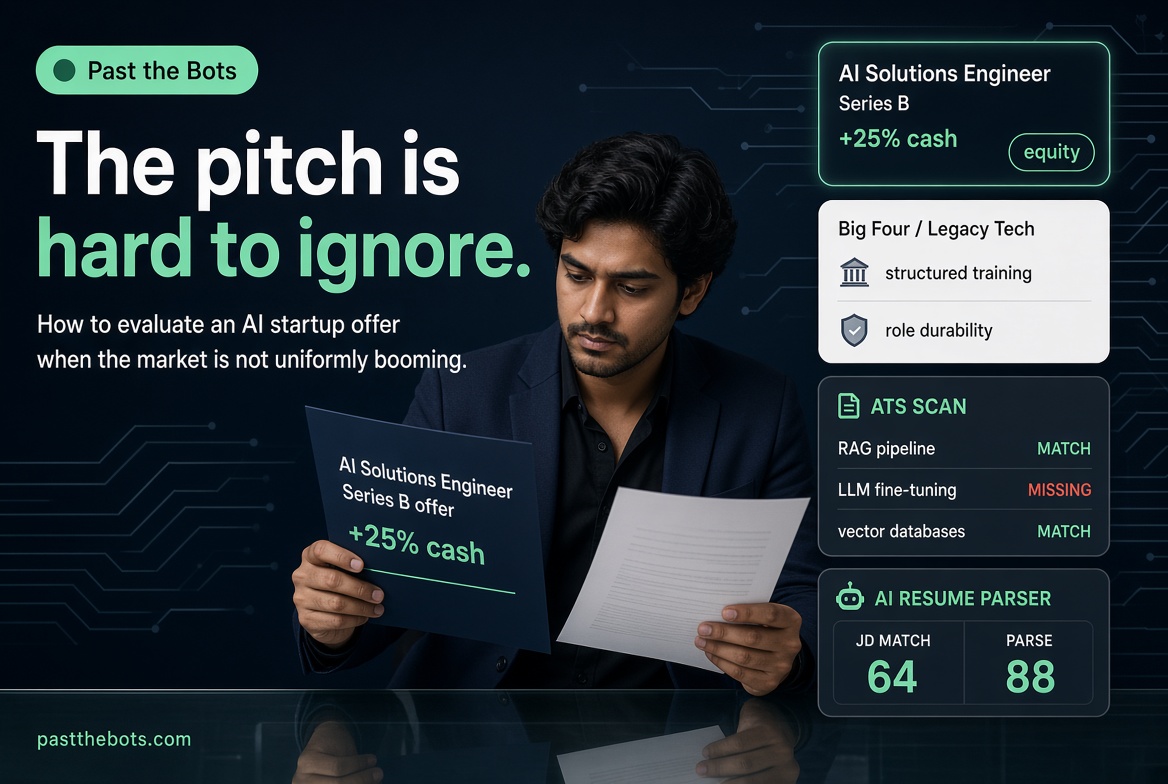 The pitch is hard to ignore: a Series B AI startup wants you to join as an "AI Solutions Engineer" or "Automation Consultant," the salary is 20-30% above what a Big Four firm or legacy tech company offered, and the role sounds genuinely exciting. For a lot of young consultants and software developers right now, that offer is landing in their inbox.
But here is the honest context: AI has been cited as a contributing factor in a significant chunk of the layoffs and planned job cuts announced heading into 2026. Entry-level software engineering roles at larger companies have quietly contracted over the past two years. The market is not uniformly booming just because AI is everywhere in the news.
So how do you make a smart call? Here is a practical framework.
Understand What You Are Actually Trading
Before you sign anything, get clear on the real tradeoffs:
- Compensation structure: Is that higher number base salary, or is it heavy on equity and variable pay? Early-stage startup equity is real compensation only if the company exits successfully, which most do not.
- Role durability: Is the job building AI infrastructure, or is it a role that exists to help a company adopt AI tools? The first is likely safer. The second could be automated itself within a few years.
- Learning trajectory: Big consulting firms and established tech companies offer structured training, mentorship, and credentials that carry weight on a resume for decades. A startup gives you speed and ownership but often little formal development.
- Funding runway: It is completely reasonable to ask how much runway the company has and when they last closed a round. A startup 18 months from needing to fundraise in a tough market is a different bet than one that just closed a Series C.
None of this means "do not do it." It means go in with your eyes open.
The Resume Signal Problem
Here is something most career articles skip: the job market you are moving into is itself highly automated. Whether you are applying to AI startups or pivoting back to enterprise tech later, your resume is going to be read by an Applicant Tracking System before a human sees it.
AI startup job descriptions tend to use very specific, sometimes niche terminology. "RAG pipeline," "LLM fine-tuning," "prompt engineering," "vector databases" -- if you have worked with these things but your resume uses vague language like "developed AI solutions," a parser may not surface you at all.
A few things worth doing right now:
- Audit your resume against real job descriptions. Paste a target job description into a tool like Past the Bots and see your actual keyword match score. You will often find that your experience is genuinely relevant but your language does not match what the system is scanning for.
- Use the exact terminology from the posting. Not to stuff keywords in, but because these are the actual words that describe what you did. If you built a retrieval-augmented generation workflow, say that.
- Rewrite bullets around outcomes, not tasks. "Built internal chatbot" is weak. "Built a RAG-based internal chatbot that reduced analyst research time by 40%" is concrete and scannable.
If You Are Staying Put (or Have To)
Not everyone is getting recruited by a hot startup, and that is fine. If you are at a company where AI-related restructuring is making your position feel uncertain, or you are an entry-level developer navigating a contracted hiring market, the move is not panic -- it is positioning.
- Document your AI-adjacent work now, even if it is small. Did you use Copilot to improve your output? Help evaluate an LLM vendor? Those belong on your resume with specifics.
- Get visible externally. A recruiter-facing profile that highlights your actual skills and what you are open to is worth more than blasting applications. The "Get Found" profile concept matters here -- recruiters sourcing for AI roles are actively looking, not just waiting for applications.
- Upskill with credentials that parse well. Short courses from Google, DeepLearning.AI, or Coursera add scannable skills to your resume. They are not a substitute for experience, but they signal direction.
The Honest Bottom Line
AI startups are a legitimate opportunity for young tech and consulting professionals, and the pay and experience can be genuinely great. But the same technology that is creating those jobs is also eliminating others, and the job search process itself is increasingly automated.
The professionals who land well in this market are the ones who understand how hiring actually works -- automated screening included -- and present their real skills in language that gets them in front of humans. That part has not changed. Only the stakes have.