Should You List Gaming on Your Résumé? Here's How to Think About It
August 18, 2026 · 4 min read · Past the Bots
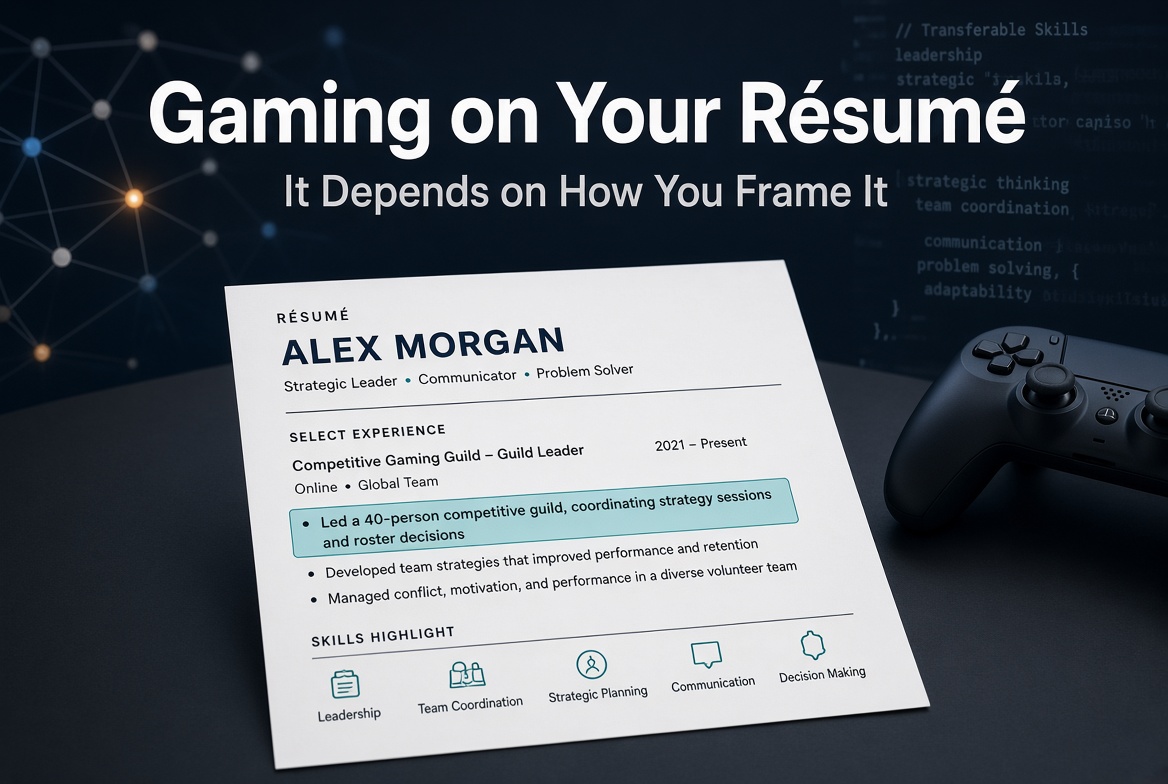 A recent article making the rounds asks whether listing gaming on your résumé could hurt your chances. The short answer is: it depends entirely on how you do it. The long answer is a lot more useful.
Let's break down when gaming experience helps, when it hurts, and how to frame it so a human hiring manager AND an ATS both take it seriously.
Why This Question Matters More Than It Used To
Gaming is no longer a niche hobby. Esports, game design, streaming, modding communities, and competitive online play involve real, measurable skills: strategic thinking, team coordination, fast decision-making under pressure, and sometimes serious technical chops.
At the same time, a recruiter who sees "Fortnite enthusiast" buried in a skills section is probably going to raise an eyebrow. Not because gaming is shameful, but because it doesn't tell them anything actionable about what you can do for them.
The résumé real estate question is always the same: does this entry help you get the interview, or does it take up space that something better could?
When Gaming Experience Is Genuinely Résumé-Worthy
Here are situations where including it makes real sense:
- You held a leadership role. Guild leader, team captain, tournament organizer. These involve managing people, resolving conflict, and hitting goals. That's leadership experience, full stop.
- You built something. Mods, indie games, custom levels, streaming setups with real audiences. These show initiative and technical skill that belong in a portfolio or a projects section.
- The job is in gaming or tech. If you're applying to a game studio, a gaming hardware company, or even certain tech roles, relevant gaming experience is a genuine signal that you know the space.
- You developed transferable skills at scale. Coaching a ranked team, running a Discord community of thousands, or competing at a high level all involve skills employers pay for.
When to Leave It Off
Be honest with yourself here. If your gaming experience is "I play a lot of games and I'm pretty good," that's a hobby, not a credential. Including it doesn't add value and can make your résumé feel unfocused.
The same goes for listing it as a "skill" alongside things like Excel or project management. ATS systems are scanning for keywords that match job descriptions. "Gaming" is almost never one of them, and it dilutes the section.
The test: Could you describe a concrete result or responsibility from this experience in one sentence? If not, leave it off.
How to Frame It If You Do Include It
The framing is everything. Here's the difference:
Weak: Hobbies: Gaming, watching sports, hanging out with friends
Stronger: Led a 40-person competitive guild in [Game], coordinating weekly strategy sessions and managing roster decisions across two active seasons
The second version reads like a real leadership role because it basically was one. Notice it includes scope (40 people), activity (coordination, strategy), and duration (two seasons). That's how you write any bullet point that wants to be taken seriously.
If you're not sure whether your bullets are landing the right way, running your résumé through a tool like Past the Bots can show you what an ATS actually extracts from your experience section. Sometimes what feels clear to you reads as noise to a parser.
What About the Skills Section?
If gaming gave you specific technical skills, those absolutely belong on your résumé, just listed by the actual skill:
- Video production and editing (from streaming content)
- Community management (from running a Discord or subreddit)
- Data analysis (yes, some competitive players do serious stat work)
- C++ or Unity (from game modding or indie development)
These are searchable keywords that match real job descriptions. "Gaming" is not.
The Bigger Lesson
The gaming question is really a specific version of a universal résumé question: how do I show that non-traditional experience counts?
The answer is always the same. Lead with what you did, who you did it with or for, and what the outcome was. Strip out the label and describe the work underneath it.
A recruiter who sees a well-framed leadership or technical bullet doesn't need to know it came from a game. A recruiter who sees "gaming" with no context will move on in about two seconds.
Your résumé is a document designed to get you a conversation. Every line should be earning that conversation. If your gaming experience can do that with the right framing, use it. If it can't, channel that energy into something that can.