Soft Labor Market: What +29K Jobs and Rising Unemployment Mean for Your Job Search
October 26, 2026 · 4 min read · Past the Bots
The Jobs Report Nobody Wanted to See
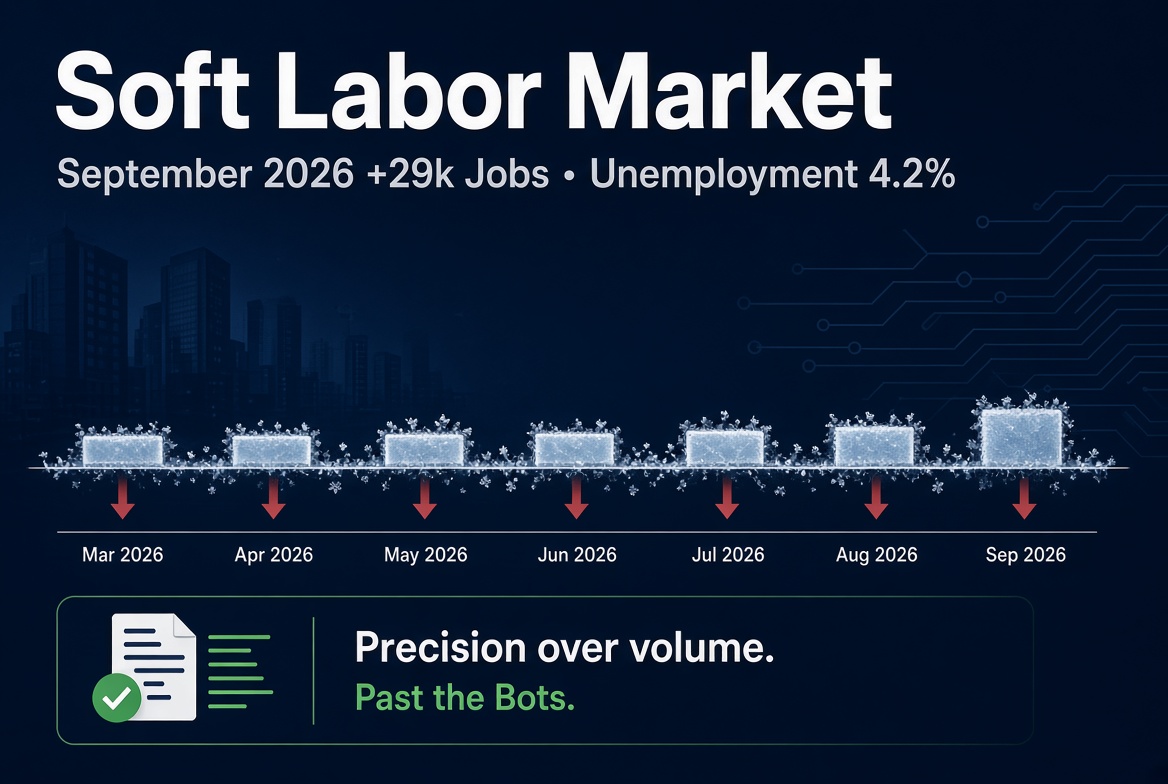
The September 2026 jobs report landed with a thud. Only 29,000 jobs added, well below the roughly 150,000 economists had expected. Prior months got revised downward. Unemployment ticked up to 4.2%. The sectors feeling it most include information services, professional and business services, and finance, which are exactly the fields where AI-driven efficiency gains have been most visible over the past couple of years.
Economists have started calling this a "low-hire, low-fire" market, and that phrase is worth sitting with. Companies aren't doing mass layoffs, but they're also barely backfilling open roles. Positions that would have been posted and filled in three weeks are either staying closed or moving through approval cycles that take months. Staffing hours ticked up in some measures, which suggests employers are squeezing more out of existing workers rather than adding headcount.
For job seekers, this creates a specific kind of frustration: the jobs are technically out there, but the pipeline moves slowly and the competition for each one is sharper.
What a Frozen Market Actually Means for Your Search
In a hot market, volume works. You apply to 40 jobs, get five callbacks, and land something. In a soft market, that math breaks down. The same 40 applications might return two callbacks, and both of those roles have 300 other applicants.
The cost of a weak application goes up significantly when hiring managers are being selective. A résumé that fails to parse cleanly in an applicant tracking system, or one that doesn't clearly reflect the language in the job description, is much easier to skip when there are plenty of other candidates in the pile.
This isn't a reason to panic. It is a reason to tighten up your materials and be more deliberate about where you spend your energy.
Three Things to Fix Before You Apply to Another Role
1. Find out what the ATS actually sees when it reads your résumé.
Most people have no idea how their résumé looks after it's been processed by an applicant tracking system. Columns collapse, tables scramble, headers get misread, and skills end up in the wrong section or disappear entirely. Before you apply anywhere else, run your résumé through a parser audit so you can see exactly what the bot extracts: your name, contact info, skills, work history, and section labels. Tools like Past the Bots show you this directly, flagging critical errors and warnings so you know what to fix.
2. Stop mass-applying and start matching.
For each role you actually care about, paste the job description and compare it against your résumé. What skills are listed in the posting that your résumé doesn't mention? Are there keywords that appear in the JD that you've described differently? In a selective market, a skills match score matters because ATS platforms rank and filter candidates before a human even gets involved.
This doesn't mean stuffing your résumé with buzzwords. It means making sure the real experience you have is described in language that aligns with what the employer is searching for.
3. Rewrite bullets to speak to the specific role.
Generic bullets like "managed projects" or "supported cross-functional teams" don't help you stand out. In a slow market, tailored bullets that reflect the actual priorities in the job description are what move you from the filtered pile to the reviewed pile. If rewriting feels tedious, AI tailoring tools can help you reshape bullets to fit a role without inventing anything you didn't do.
Longer Searches Reward a Different Kind of Work
If your search is going to take longer because the market is slower, that time is best spent on quality rather than volume. A few specific things that pay off:
- Clean up your résumé format. Single-column layouts parse better across virtually every ATS platform. Fancy formatting that looks great in PDF form often turns into a mess after parsing.
- Build a presence that recruiters can find. In a low-hire market, passive recruiting still happens. A strong talent profile with the right skills and keywords can bring inbound interest even when you're not actively applying.
- Write better outreach. A personalized note to a recruiter or hiring manager that references the specific role and your relevant background is far more effective than a generic connection request.
The Upside of a Slow Market
Here's something that often gets lost in the doom-and-gloom coverage: a slower market filters out lazy applications. If you take the time to fix your résumé, tailor your materials, and reach out thoughtfully, you are automatically ahead of a large chunk of your competition who is still blasting the same PDF to every open role on LinkedIn.
The market will eventually move. In the meantime, precision beats volume.