Stop Applying Blind — See Your Real Match Score Before You Hit Submit
July 21, 2026 · 4 min read · Past the Bots
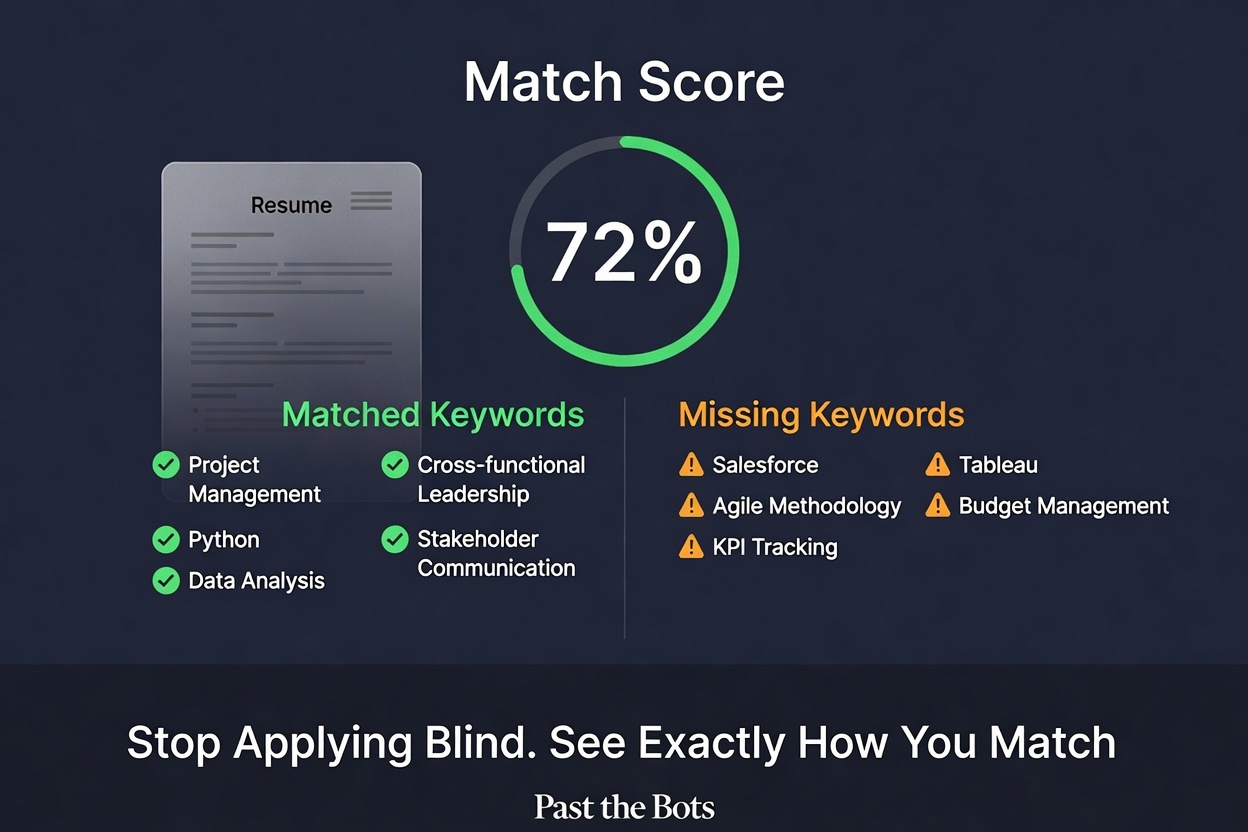 Most job seekers operate on gut feeling. You read a posting, think "yeah, I could do that," and hit submit. Then you wait. And wait. And hear nothing.
Here's the uncomfortable truth: your gut isn't what the ATS is reading. The system is doing a cold, mechanical comparison between the words in the job description and the words in your resume. If they don't line up closely enough, your application gets filtered out before a human ever sees it.
The good news? You can see exactly how that comparison plays out before you apply.
What a Match Score Actually Tells You
A match score isn't just a vanity number. When it's done right, it breaks down into things you can actually act on:
- Which skills and keywords from the job description appear in your resume (matched keywords)
- Which ones are missing entirely (missing keywords)
- Which gaps are likely knockout criteria versus nice-to-haves
That last point matters a lot. Not every missing keyword carries the same weight. "Python" listed in the first bullet of a requirements section is treated very differently than "familiarity with Agile" buried in the final paragraph. A good match tool weights those accordingly so you know where to focus your energy.
The Difference Between Matched and Present
Here's something that trips people up: a skill can exist in your resume and still not register as a match.
Maybe the job posting says "project management" and your resume says "led cross-functional initiatives." You did the work. But the ATS doesn't always make that connection. It's looking for the specific phrase, not the concept behind it.
This is why scanning your resume against a job description is so useful. You might discover that you actually have 80% of what they're asking for, but your resume is only communicating 40% of it because you used different language. That's a fixable problem.
How to Use a Match Score Without Gaming the System
There's a wrong way to use keyword data: stuffing terms into your resume whether they apply to you or not. That backfires fast. Recruiters notice when a resume reads like a word cloud, and fabricating experience you don't have is never the answer.
The right approach is to look at the missing keywords and ask yourself three questions:
- Do I actually have this skill or experience? If yes, you probably just need to name it more explicitly.
- Have I done something adjacent? If the job asks for "Salesforce" and you've used HubSpot or another CRM, that's worth noting in context.
- Is this a genuine gap? If so, is it a dealbreaker or something you could address in a cover letter or learn quickly?
When a keyword is legitimately yours and you're just not using the right terminology, rewriting that bullet to reflect the job's language is fair game. That's not deception, that's translation.
Seeing How You Stack Up
Match scores are even more useful when you have some sense of how other applicants are performing. If you're scoring a 58% match on a role that's been posted for two weeks, knowing that competitive candidates are typically landing above 75% tells you something important: either this application needs more work, or this might not be the right fit.
That context helps you make smarter decisions about where to invest your tailoring time. Spending two hours polishing an application where you're fundamentally underqualified is time that could have gone toward a role where you're at 70% and a few targeted tweaks could push you over the threshold.
A Practical Workflow Before You Apply
Here's a simple process you can build into every application:
- Paste the job description into a match tool and run your current resume against it
- Review matched keywords to confirm your resume is getting credit for what you actually have
- Look at missing keywords and decide which ones you can honestly add or surface more clearly
- Check for knockout gaps so you're not surprised later
- Rewrite the relevant bullets to reflect the job's language more closely
- Run the scan again to see how your score moved
This process takes 20 to 30 minutes. That's a small investment compared to the hours most people spend applying to dozens of roles and hearing nothing back.
Past the Bots builds this workflow into the resume scanner, including the weighted match score, matched and missing keyword lists, and knockout gap flags, so you can see exactly where you stand and make targeted fixes before you submit.
Applying blind is easy. Applying smart is what gets you the interview.