The 10 Most AI-Proof Jobs Right Now (And How to Actually Get Hired for Them)
October 9, 2026 · 4 min read · Past the Bots
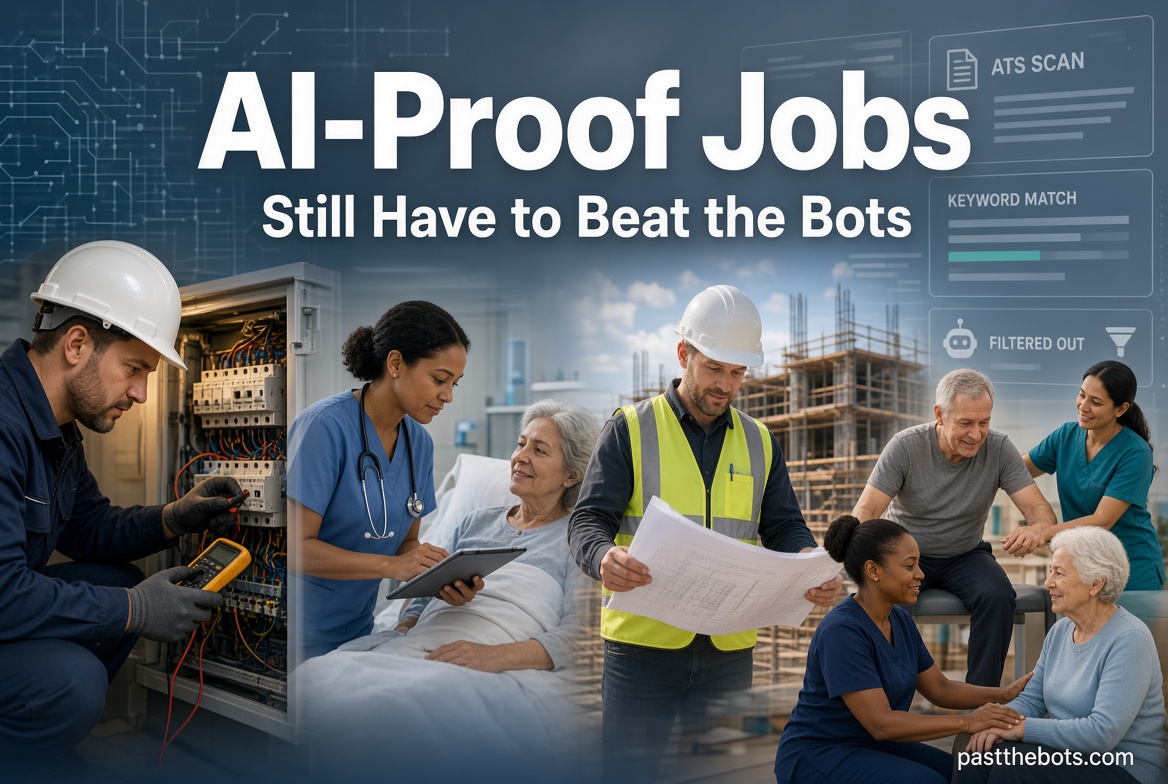 A recent report making the rounds highlighted the top 10 jobs least likely to be disrupted by AI. The common thread? None of them are desk jobs. We're talking roles like:
- Electricians and plumbers who troubleshoot physical systems on the fly
- Home health and personal care aides who provide hands-on support and emotional connection
- Construction managers who coordinate complex, unpredictable job sites
- Athletic trainers and physical therapists who read bodies, not spreadsheets
- Childcare workers and preschool teachers who build trust with kids and families
- Nurses and surgical technologists who make real-time clinical judgments
These roles require physical presence, human judgment, emotional intelligence, and adaptability. A language model can not replicate the moment a nurse notices something is off with a patient before any monitor does, or the way an electrician diagnoses a weird intermittent fault by sound.
So if you're in one of these fields, or thinking about pivoting into one, the job market outlook is genuinely good. Demand is strong, automation pressure is low, and wages in many of these trades are rising fast.
But here's the catch.
Getting Hired Still Means Getting Past the Bots
Even for jobs that require someone to physically show up and do skilled work, hiring often starts online. Applications go through an Applicant Tracking System. Résumés get parsed, scored, and filtered before a human ever reads them. That's true for hospital systems hiring nurses, large contractors hiring project managers, and staffing agencies filling trades positions.
And here's where a lot of skilled workers get tripped up. If your résumé is formatted in a way that confuses an ATS parser, or if it doesn't surface the right keywords for the role, you can be screened out before anyone sees your actual qualifications.
This is frustrating when you have five years of hands-on experience and a stack of certifications. You're not competing against AI for the job itself. But you are competing against it in the hiring process.
What ATS Systems Actually Look For in These Roles
For trades, healthcare, and hands-on roles, parsers are typically scanning for a few specific things:
- Licensure and certifications (CNA, RN, OSHA 10/30, journeyman license, CPR, etc.)
- Hard skills tied to tools, equipment, or techniques (PLC programming, wound care, forklift certification, ECG interpretation)
- Location or travel availability, which matters a lot for field roles
- Years of experience, often pulled from job dates
The problem is that many résumés in these fields were written once, years ago, and haven't been updated to match how modern job postings are worded. A home health aide who writes "assisted clients with daily living" might be missing the exact phrase "ADL support" that a hospital system's ATS is filtering for.
How to Close That Gap Without Rewriting Your Whole Résumé From Scratch
This is exactly where a tool like Past the Bots helps. You paste in your résumé and a job description, and it shows you:
- What the ATS actually extracts from your résumé, including your name, contact info, skills, and work history sections, so you can see if anything is getting lost or misread
- A keyword match score against the specific job posting, with matched skills highlighted and missing ones flagged
- Which gaps are knockout risks, meaning the terms that are likely weighted heavily in screening
- Rewritten bullet points that bring your real experience in line with how the job is described, without inventing anything you didn't actually do
For a surgical tech applying to a new hospital system, that might mean making sure "sterile field maintenance" and "instrument counts" appear explicitly rather than being buried in vague language. For an electrician targeting commercial projects, it might mean surfacing "conduit bending," "load calculations," or specific code knowledge that a staffing ATS is scanning for.
The Bigger Picture
The report is right that these jobs are AI-proof in the sense that matters most: a robot is not going to replace a skilled nurse or master electrician anytime soon. The physical, relational, and judgment-based nature of the work protects it.
But the front door to these jobs, the application and screening process, is increasingly automated. That's not going away.
The good news is that fixing your résumé for ATS is not complicated once you can see exactly what the system is reading. A quick audit, a few targeted keyword additions, and cleaner formatting can be the difference between getting a callback and getting filtered out.
Your skills are human. Your application process doesn't have to work against you.