The 108-Day Job Search (and Why Volume Is Killing Results)
October 29, 2026 · 4 min read · Past the Bots
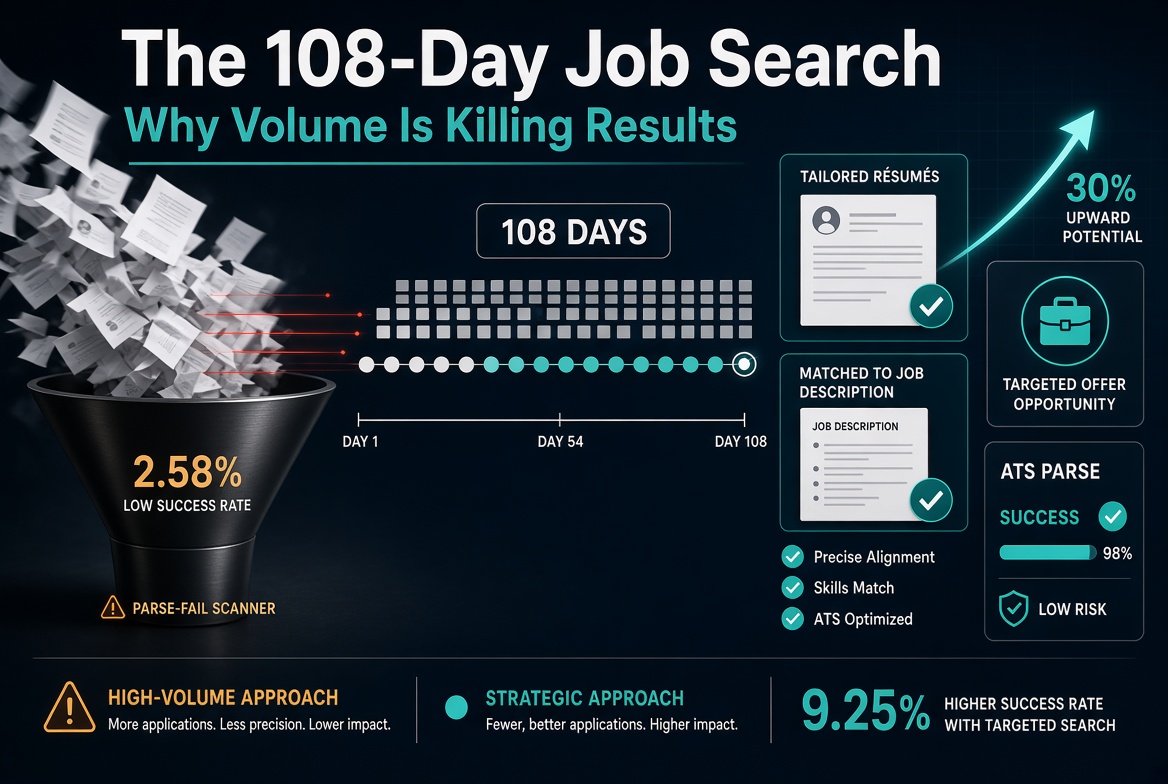 If your job search is starting to feel like a second full-time job with no paycheck, you are not imagining things. Huntr's Q1 2026 Job Search Trends Report found that the median time from search start to first offer has hit 108 days -- up 30% from Q4 2025 and the longest stretch they have ever recorded.
That is three and a half months of applications, silence, and the occasional rejection email. For a lot of people, the instinct is to send more. More applications, more platforms, more volume. The data says that instinct is exactly wrong.
The Volume Trap Is Real
Here is the number that should stop you mid-scroll on LinkedIn: job seekers who sent 11 to 20 applications interviewed at a rate of 9.25% per application. Those who sent 100 or more interviewed at just 2.58% per application.
That is a 3.5x difference in interview rate, and the people grinding through triple-digit application counts are getting worse results, not better. More effort, less outcome.
Why does this happen? A few reasons stack up:
- Generic resumes don't match job descriptions. When you are sending 10 applications a day, there is no time to tailor anything. ATS systems rank candidates partly on keyword alignment, so a resume that isn't tuned to the specific role gets scored low before a human ever sees it.
- Same-company multi-applies hurt you. Huntr's data also flags this: applying to multiple roles at the same company signals desperation to recruiters and can get you quietly flagged in the ATS as a low-fit candidate.
- Parse failures wipe out strong candidates silently. Your resume might look great as a PDF. But if the ATS mangles your contact info, misreads your job titles, or skips your skills section entirely, none of the tailoring matters. You are invisible.
What "Tailored" Actually Means
The report confirms what most career coaches have been saying for years: tailored resumes outperform generic ones. But "tailored" gets thrown around loosely, so let's be specific about what it means in practice.
Tailoring is not just swapping in the company name or copying a few words from the job posting into your summary. Real tailoring means:
- Matching the exact language the job description uses for skills and responsibilities. If the JD says "cross-functional collaboration" and your resume says "worked with other teams," an ATS keyword scan may not connect those dots.
- Prioritizing the bullets that are most relevant to this specific role. A project manager applying to a construction-focused company should lead differently than the same PM applying to a SaaS startup.
- Closing knockout gaps before you apply. Some requirements are filters, not preferences. If the JD requires PMP certification and you don't mention yours, that can be an automatic disqualifier even if you have it.
This is where a tool like the skill-weighted match score in Past the Bots earns its keep. Paste in a job description and you can see exactly which keywords you are matching, which ones are missing, and which gaps are likely to be knockout criteria. That takes the guesswork out of the tailoring process and tells you where to focus the 20 minutes you have to revise a resume.
Fix the Foundation Before You Send Anything
Here is something that does not get talked about enough: you can tailor a resume perfectly and still get filtered out because the ATS could not read it.
Complex formatting, multi-column layouts, headers and footers with contact info, tables used to organize skills -- these are all common resume choices that look clean in Word or Google Docs and turn into gibberish inside a parser. An ATS that cannot extract your name and email reliably is not going to rank your keyword match accurately either.
Before you send your next batch of applications, it is worth running your resume through a parser audit to see what the system actually extracts. What shows up as your name? Did your skills get captured? Are your job dates readable? These are fixable problems, but only if you know they exist.
The Math of a Better Search
If the median search is now 108 days, every week you spend sending low-quality volume applications is a week you could have spent on five well-matched, properly formatted, keyword-aligned ones.
The candidates who are compressing that timeline are not the ones with the best resumes in a vacuum. They are the ones whose resumes actually get read by the ATS, score well against the job description, and land in the "worth a call" pile instead of the rejection queue.
Fewer applications. Better matches. Clean formatting the parser can handle. That is the job search strategy the data is pointing to right now.