The Career Pivot Thread That Broke the Internet (And What It Takes to Actually Make the Jump)
October 4, 2026 · 4 min read · Past the Bots
 A few weeks ago, a Threads post asked people to share their most dramatic career pivots. The replies exploded.
Corporate lawyer turned coffee-shop owner. Graphic designer turned firefighter. House cleaner turned published author. Thousands of people liked, reposted, and replied with their own stories. The comments were full of "this is me" and "I needed to see this today."
It clearly hit a nerve. A lot of people are exhausted by work that pays the bills but drains everything else. And more of them than you might think are quietly plotting an exit.
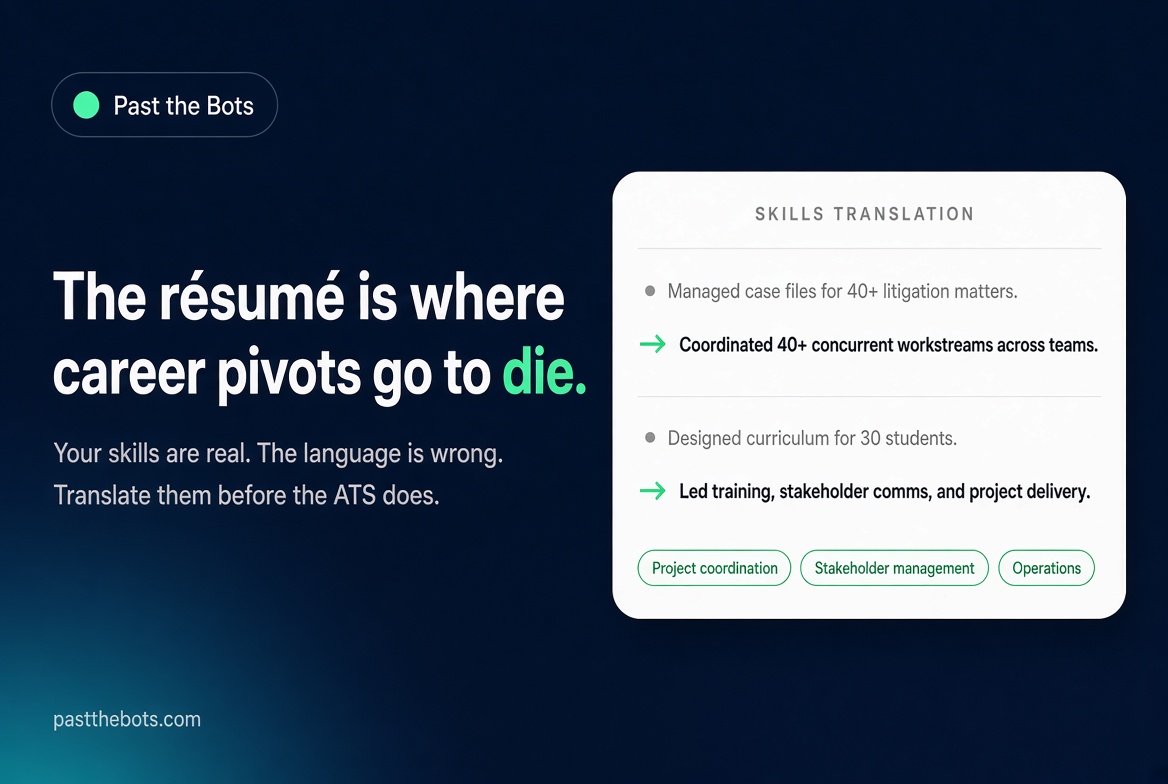
But here's the part nobody talks about in those feel-good threads: the résumé is where career pivots go to die.
Not because your experience is wrong. Because the way it's presented makes hiring managers (and the ATS software screening you before a human ever reads your file) assume you're wrong for the role.
Let's fix that.
Why Career Changers Get Screened Out Before Anyone Sees Them
Most Applicant Tracking Systems are keyword-matching tools. They scan your résumé for terms that appear in the job description. If you spent eight years as a paralegal and you're applying for a project management role, the system doesn't see "highly organized person who managed complex timelines and juggled twelve stakeholders at once." It sees a résumé with no PMP, no Agile, no project management keywords, and it moves on.
This is the core problem for career changers. Your skills are real. Your value is real. But your language is wrong for the new field, and the bots don't speak nuance.
Step One: Figure Out What Actually Transfers
Before you touch your résumé, do an honest skills audit. Grab a few job postings in your target field and read them carefully. Then look at your own history and ask: where did I actually do this, even if I called it something different?
Some examples:
- A teacher who managed 30 students, designed curriculum, and handled parent communication has project management, stakeholder communication, and training and development experience.
- A restaurant manager who controlled food costs, scheduled staff, and hit revenue targets has budget management, workforce planning, and operations experience.
- A graphic designer who pitched concepts to clients and revised based on feedback has client relations and iterative problem-solving experience.
The work is the same. The vocabulary is different. Your job is to translate.
Step Two: Rewrite Bullets in the New Language
This is where most people get stuck. They either undersell (keeping old jargon that means nothing in the new field) or they oversell (claiming skills they don't actually have, which falls apart fast in an interview).
The goal is accurate translation, not fabrication.
Take a bullet like: "Managed case files for 40+ active litigation matters."
For a project management role, that becomes: "Tracked and coordinated 40+ concurrent workstreams, maintaining deadlines and documentation across cross-functional teams."
Same experience. New language. Honest. Relevant.
If you use Past the Bots, the AI tailoring tool does exactly this kind of rewrite -- it takes your actual bullets and reshapes them to match a specific job description without inventing experience you don't have. It's worth running your pivot résumé through it for any role you're serious about.
Step Three: Fix Your Skills Section (The Bots Are Watching It)
For career changers, the skills section is critical real estate. This is where you can explicitly name the transferable skills in the language of the new field, even if your job titles don't reflect them yet.
Don't just list soft skills like "leadership" and "communication" -- those are invisible to most ATS filters. Get specific:
- Instead of "leadership," try team management or cross-functional collaboration
- Instead of "organized," try project coordination or workflow optimization
- Add hard skills you genuinely have: tools, certifications, methodologies
Running your résumé through an ATS scanner (like the one in Past the Bots) can show you exactly what's being extracted from your skills section right now, so you're not guessing.
Step Four: Write a Summary That Does the Work Upfront
Career changers need a strong professional summary more than anyone. You have maybe three seconds before a human reader makes a judgment. Use those three seconds to connect the dots yourself, instead of hoping they'll connect them.
Something like: "Operations professional with 10 years in hospitality management transitioning into supply chain coordination. Proven track record in vendor relationships, inventory control, and team scheduling across high-volume environments."
Short. Direct. It frames the pivot before any confusion sets in.
The People in That Thread Figured Out the Hard Part
Deciding to make the leap is genuinely the hardest thing. If you've done that, the résumé is a solvable problem. It's a document. You can rewrite it.
The viral thread worked because it reminded people that dramatic pivots are possible. This post exists to remind you that they're also practical -- if you do the translation work and make sure the right systems can actually read what you bring to the table.