The False-Reject Problem: When Good Candidates Never Reach a Human
September 24, 2026 · 4 min read · Past the Bots
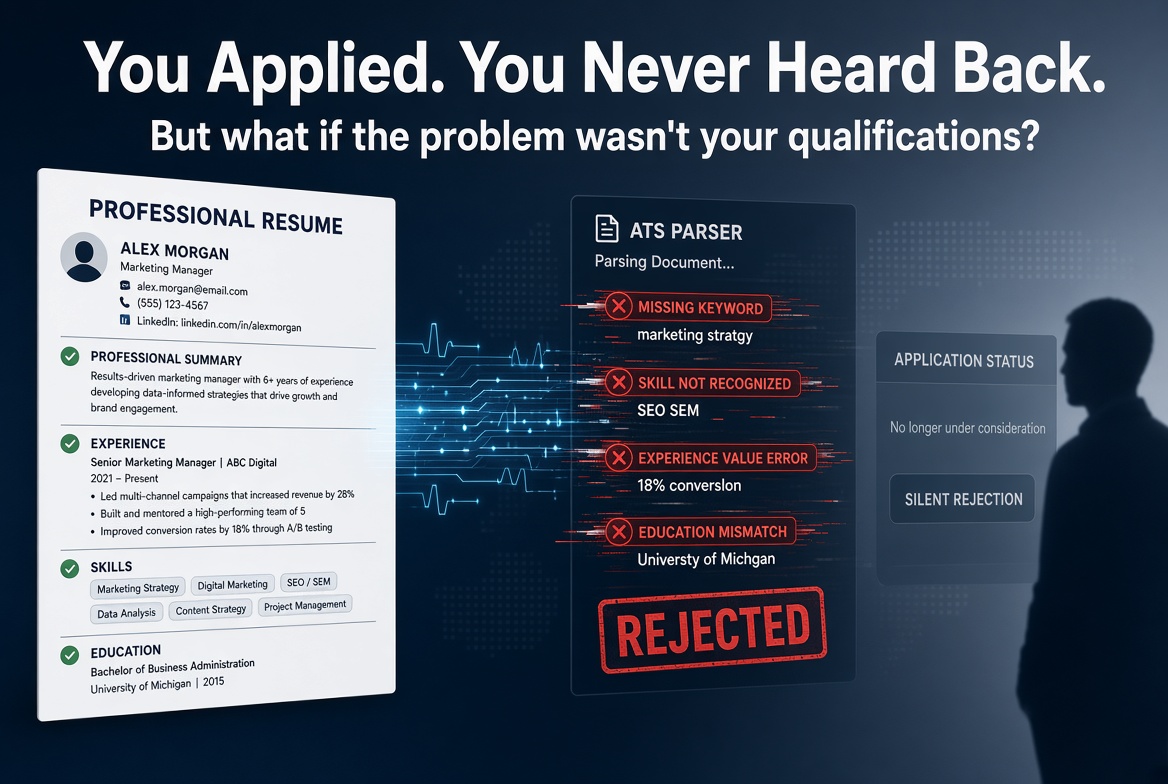 You applied. You never heard back. You assumed you weren't qualified enough.
But what if the problem wasn't your qualifications at all?
This happens more than most people realize. A perfectly capable candidate submits a resume, the automated system misreads or misscores it, and the application lands in a reject pile before a single human being lays eyes on it. Recruiters call this a false negative. Job seekers usually just call it silence.
Let's break down exactly how this happens, and what you can do about it.
How ATS Filters Actually Work
Applicant Tracking Systems are not reading your resume the way a person does. They're parsing it, meaning they're extracting structured data from an unstructured document. Name, contact info, job titles, dates, skills, and education all get pulled into fields in a database.
Then, depending on the company's setup, the system scores or filters that parsed data against the job requirements. If your resume doesn't hit certain thresholds, it may never surface in a recruiter's queue.
The catch: the parsing step is where a lot of things go wrong.
Common Ways Good Resumes Get Misread
Here are the most frequent culprits behind false rejections:
Unusual formatting. Two-column layouts, text boxes, headers and footers, and tables look great in Word or a PDF viewer. But many parsers can't read them reliably. Skills listed in a sidebar column sometimes get dropped entirely. Contact info tucked into a header may never get extracted.
Creative section labels. If your work history section is titled "Where I've Made an Impact" instead of "Experience" or "Work History," some systems simply won't recognize it as a job section. Your entire employment record can go missing from the parsed output.
Skill phrasing mismatches. A job description asks for "project management" and you wrote "managing cross-functional projects." A human reads those as the same thing. Many parsers do not. If your wording doesn't match the keywords the system is scanning for, you may score lower than a weaker candidate who happened to use the exact right phrase.
Buried or missing keywords. ATS scoring often weights skills by where they appear and how often. A skill mentioned once in a bullet near the bottom of page two carries less weight than one that also appears in a summary.
Knockout question misalignment. Some systems use hard filters before scoring even starts. If the job requires a specific certification, degree, or years of experience and those details aren't clearly parseable in your resume, you can get screened out automatically, even if you actually meet the requirement.
The Frustrating Part
You rarely get feedback. The rejection email, if one comes at all, says something like "we've decided to move forward with other candidates." There's no way to know if you failed a keyword match, if your formatting broke the parser, or if a human ever looked at your resume at all.
This is what makes the false-reject problem so damaging. It's invisible to the candidate.
How to Catch These Issues Before You Apply
The most effective thing you can do is see your resume the way a parser sees it, before you submit it.
This is exactly what the Audit the Bots feature in Past the Bots is built for. It shows you how different parsers actually read your resume, not how it looks on your screen. You can see whether your name and contact info got extracted correctly, whether your job sections were recognized, and whether your skills actually registered.
The ATS scan goes further, flagging specific issues as critical, warning, or OK. Things like missing section headers, unreadable formatting, or contact details that didn't parse correctly show up as actionable fixes, not vague suggestions.
For skill matching, the job description match tool compares your resume against a specific posting and shows you which keywords matched, which are missing, and whether there are any knockout gaps you need to address. This is where you can see, concretely, whether your phrasing is working against you.
If you need to close those gaps, the AI tailoring tool rewrites your existing bullets to better reflect the job's language, without inventing experience you don't have. You're not stuffing in keywords. You're making sure your real experience is actually legible to the system evaluating it.
The Bottom Line
Being qualified for a job is not enough if the system filtering applications can't accurately read your resume. False rejections are a real, documented problem, and they're not a reflection of your ability.
The good news is that most of the issues causing them are fixable. You just need to see them first.
Check your resume before your next application. Not just how it looks, but how it parses. That one step can be the difference between a rejection that was never really about you, and actually getting a call.