The Fastest-Growing Trades You Should Know About (Even If They Don't Pay the Most Yet)
October 27, 2026 · 4 min read · Past the Bots
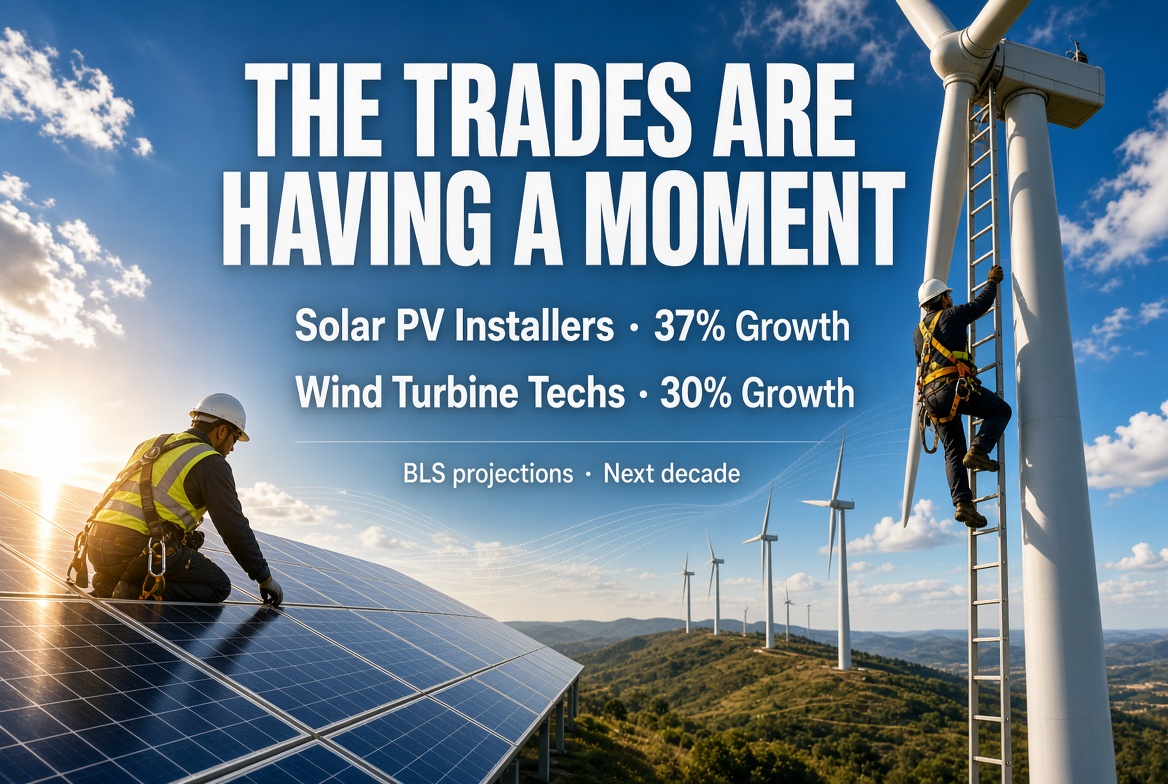 The trades are having a moment, and not just the usual suspects like electricians and plumbers. Two roles are quietly outpacing almost every other occupation in the country: solar photovoltaic installers (projected 37% growth over the next decade) and wind turbine service technicians (around 30%). Both numbers come from the Bureau of Labor Statistics, and both are roughly five to seven times the average growth rate for all occupations.
So what's driving it, and what does it mean if you're considering one of these paths or are already working in the field?
Why the Numbers Are This High
Two forces are pushing demand through the roof. First, the ongoing energy transition is real and it's accelerating. Utility-scale solar farms, rooftop installations, and commercial projects are getting funded at a pace that installers can barely keep up with. Second, electricity demand itself is climbing, partly because of data centers, EV charging infrastructure, and electrification of heating. More electrons needed means more generation capacity, which means more panels on roofs and more turbines on ridgelines.
These aren't speculative projections tied to some distant policy goal. The projects are already permitted and under contract. The bottleneck is workers.
The Pay Conversation (Let's Be Honest)
Here's where it's worth being straight with you. Starting pay in both roles is more modest than some other trades. The median annual wage for solar PV installers is around $47,000-$48,000. Wind turbine techs do a bit better, closer to $56,000-$57,000, partly because the work involves more specialized diagnostics and the job sites are remote enough to command higher compensation.
For comparison, electricians and elevator installers still earn more at the median. So if your only priority is maximizing starting pay, there are trades with a faster path to higher earnings.
But if you're weighing long-term trajectory, the picture gets more interesting. Experienced solar techs who move into system design, project supervision, or sales engineering regularly earn six figures. Wind techs who specialize in SCADA systems, power electronics, or blade inspection can command strong salaries and are often recruited hard by developers and O&M contractors. The growth in the field means the career ladder is still being built, which cuts both ways: there's less established structure, but also less competition for the rungs above entry level.
What Your Résumé Needs to Say
This is where a lot of people leave opportunity on the table. ATS systems at solar developers, EPC contractors, and wind O&M companies are scanning résumés for specific terms before a human ever sees the file. If your résumé uses vague language, you may not make the cut even if you're genuinely qualified.
Some concrete things to include if they apply to you:
- Certifications: NABCEP PV Installation Professional or Associate credential is the gold standard for solar. OSHA 10 or OSHA 30 is expected at most commercial sites.
- Equipment and tools: Inverter brands (SMA, Enphase, SolarEdge), conduit bending, string testing, IV curve tracing, thermal imaging.
- Wind-specific: GWO (Global Wind Organisation) Basic Safety Training, specific turbine OEM platforms (Vestas, Siemens Gamesa, GE), gearbox inspection, pitch and yaw system work.
- Soft but real skills: Comfort with heights, valid driver's license for rural sites, ability to read single-line diagrams.
If you're not sure whether your résumé is actually surfacing these terms in a way parsers can read, tools like the ATS scanner at Past the Bots can show you exactly what a system extracts from your file and flag anything that's getting lost in formatting.
Where the Jobs Actually Are
Solar installation jobs are distributed pretty broadly because projects follow sunlight and local incentives. Texas, California, Florida, and the Southeast are all active markets right now. Wind is more geographically concentrated in the Great Plains, Midwest, and increasingly offshore along the Atlantic coast.
If you're open to relocating, or if you're in a region with active development, the job board situation is better than it looks at first glance. Many openings are posted by smaller EPC firms and subcontractors who don't have big recruiting budgets, so they're not always on the biggest job boards. LinkedIn, indeed, and direct company career pages are all worth checking, but so are local IBEW chapters and trade association job boards like those run by SEIA (Solar Energy Industries Association).
The Bottom Line
37% and 30% growth rates are not normal. They signal a field that genuinely needs people, and that kind of demand tends to push wages up over time as competition for workers increases. If you're early in a trades career or considering a pivot, these roles are worth taking seriously, especially if you can stack the right certifications and make sure your résumé actually communicates what you know.