The Gen X Job Search Reality Check: How to Modernize Your Résumé Without Losing What Makes You Valuable
October 18, 2026 · 4 min read · Past the Bots
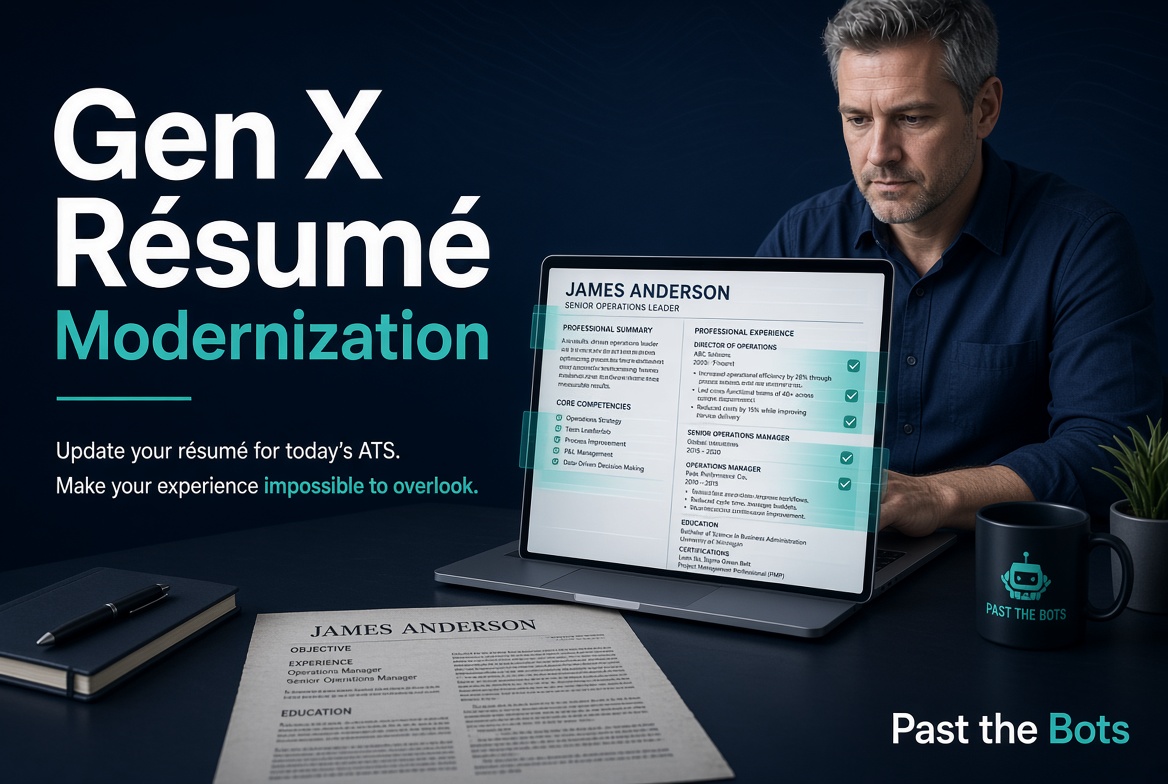 If you're somewhere between your late 30s and late 50s and the job market feels particularly brutal right now, you're not imagining it. Recent data from job search platforms suggests that mid-career workers are absorbing a disproportionate share of AI and automation-related displacement, with some estimates putting that figure around 26% of reported job losses. Add a frozen hiring market, slower reemployment timelines for longer-tenured workers, and the slow-motion collapse of the traditional career ladder, and you've got a genuinely tough moment to be job searching.
The good news: your experience is real and it's valuable. The problem is that a lot of Gen X résumés are formatted in ways that modern applicant tracking systems simply cannot read correctly, which means your 20-plus years of hard-won expertise is getting filtered out before a human ever sees it.
Here's how to fix that.
Why Older Résumé Formats Break Modern ATS Parsers
If your résumé was built in Microsoft Word in 2012 and has been updated in place ever since, it's probably carrying some structural baggage. Common culprits include:
- Tables and text boxes used for layout (parsers often skip these entirely or read them out of order)
- Two-column formats that cause ATS software to read across columns instead of down, scrambling your work history
- Headers and footers containing your contact info (many parsers ignore headers and footers completely)
- Fancy fonts and graphics that confuse extraction engines
- Section labels that don't match standard terminology, like calling your work history "Professional Journey" instead of "Work Experience"
The fix isn't glamorous but it works: a clean, single-column format with standard section headers, your contact info in the main body, and no tables. That's it. Tools like the ATS rebuild feature in Past the Bots can restructure your existing résumé into a parser-safe format without you having to start from scratch.
How to Surface Newer Skills Without Looking Like You Stuffed Them In
One of the trickiest parts of a mid-career résumé update is showing that you've kept up with how work actually happens now, without making it look like you panic-added "AI," "Agile," and "cloud" to a résumé that was otherwise written in 2008.
A few things that actually help:
- Be specific about tools, not just categories. "Data analysis" is vague. "Built dashboards in Tableau and Power BI to track regional sales performance" tells the parser what to extract and tells the hiring manager what you actually did.
- Update your bullets to include outcomes. Mid-career professionals often undersell results because earlier in their careers, listing duties was enough. Now, every bullet should answer: so what happened?
- Add a skills section that reflects current terminology. If you've been managing remote teams, say remote team leadership. If you've been using project management software, name it. ATS systems are looking for keywords that match job descriptions, and "managed cross-functional teams" without the supporting vocabulary can miss.
- Don't hide your recent learning. If you've taken a course, earned a certification, or started using new tools in the last two or three years, those belong on the résumé. A short "Professional Development" section near the bottom handles this cleanly.
The Transferable Skills Problem
Here's something that trips up a lot of experienced job seekers: the skills that make you genuinely good at your job often don't appear anywhere on your résumé, because you've never had to explain them before. They were just... obvious to everyone around you.
Things like navigating organizational politics, mentoring junior staff, managing vendor relationships, keeping projects moving when resources disappear, knowing which problems actually need to escalate and which ones you just handle. These are real skills with real market value, and they're increasingly hard to find.
The challenge is translating them into language that both ATS parsers and hiring managers recognize. When you run your résumé against a specific job description, you can see exactly which keywords you're matching and which ones you're missing. Sometimes the gap isn't a skills gap at all, it's a vocabulary gap. You have the experience, you just haven't used the words the system is looking for.
One More Thing: Your Résumé Is Not a Career Obituary
A lot of mid-career résumés read like a complete record of everything someone has ever done, which is understandable but counterproductive. You don't need to list every job going back to your first post-college position. You don't need to detail responsibilities from 15 years ago with the same depth as last year.
Focus the top two-thirds of your résumé on the last 10 to 12 years. Let older experience exist but summarize it. Make the document about where you're going, not just where you've been.
You've put in the time. The goal now is making sure the systems standing between your résumé and a real human being can actually see it.