The Skills That Make You 42% More Likely to Land a Job (And How to Make Sure ATS Actually Sees Them)
October 13, 2026 · 4 min read · Past the Bots
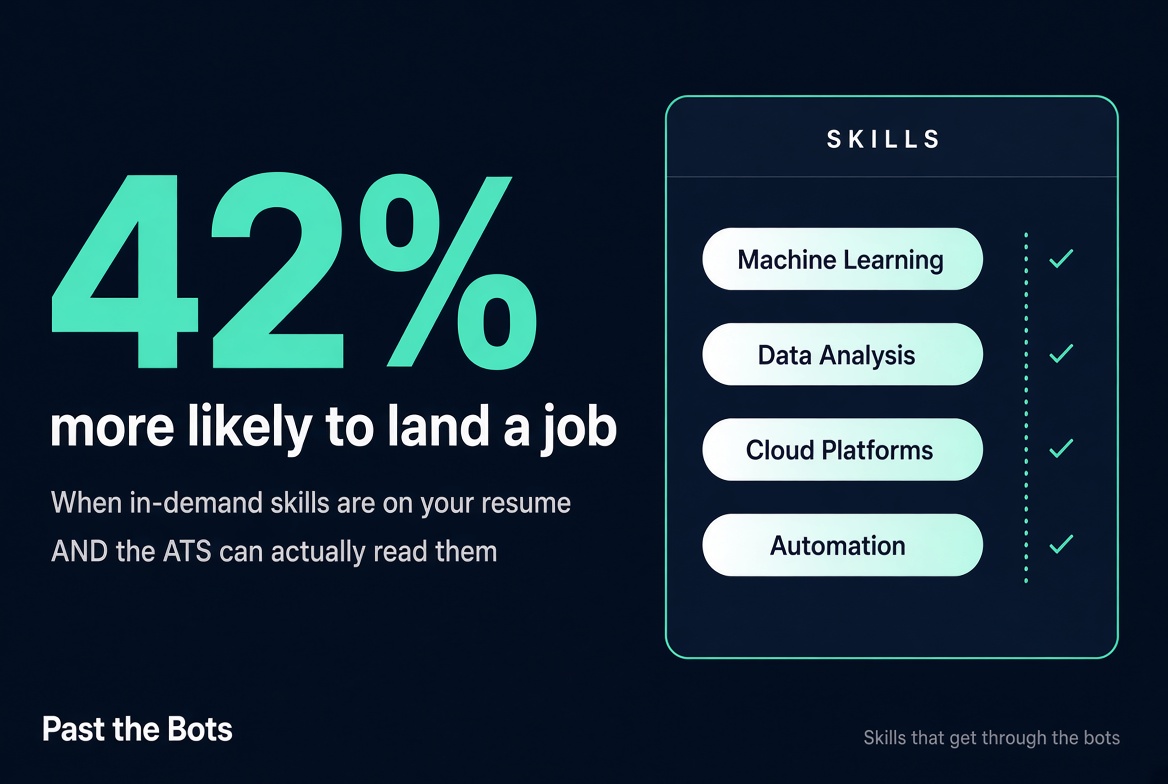 A recent analysis of millions of job postings and hiring outcomes found something pretty striking: job seekers who listed certain high-demand skills on their résumés were 42% more likely to land a job than candidates who left those skills off. Forty-two percent. That's not a rounding error. That's the difference between getting a callback and getting ghosted.
The skills driving that gap tend to cluster around a few areas: AI and machine learning tools, data analysis, cloud platforms, and increasingly, the ability to work with automation software. But here's the thing most articles about this finding skip over entirely: it doesn't matter if you have those skills if your résumé doesn't surface them in a way that ATS software can actually read.
Why Having the Skill Isn't Enough
Applicant Tracking Systems don't read your résumé the way a human does. They parse it, extract text, and look for keyword matches against the job description. If your résumé is formatted in a way that confuses the parser, or if you're using a slightly different version of a skill name than the job posting uses, you can drop out of the results entirely.
Some common ways candidates accidentally hide their skills:
- Putting skills in a text box or table. Many ATS parsers skip over these entirely or read the contents as garbled nonsense.
- Using acronyms without spelling them out. A job posting might say "machine learning" while your résumé only says "ML." They're the same thing to you, but not always to a parser.
- Burying skills in a wall of text. If your skills section is just a paragraph, some parsers won't categorize them correctly.
- Using a two-column layout. Column-based résumés are visually appealing but notorious for getting scrambled by ATS software.
How to Actually Get Credit for the Skills You Have
Let's get practical. If you have in-demand skills, here's how to make sure they register.
1. Match the exact language in the job description. If the posting says "Power BI" and you wrote "Microsoft Power BI," you might be fine. But if it says "natural language processing" and you wrote "NLP," run both versions. Use the full term at least once, then abbreviate if you want. You can use a tool like Past the Bots to paste in a job description and see exactly which keywords you're matching and which ones you're missing before you apply.
2. Give your skills section real structure. A clean bulleted or comma-separated skills list in a single-column layout is the most parser-friendly format. Avoid graphics, icons, star ratings, or anything that tries to visually represent your proficiency level. Parsers can't interpret a row of filled-in circles as "expert in Python."
3. Don't just list skills. Show them in your bullets too. A skills section alone isn't enough context. Back up each key skill with at least one bullet in your experience section that shows how you used it. "Proficient in Salesforce" is easy to claim. "Built automated lead-scoring workflows in Salesforce that reduced sales cycle time by 18%" is much harder to dismiss.
4. Tailor for every application. This sounds exhausting, but it doesn't have to mean rewriting your whole résumé. Focus on your skills section and your top two or three bullet points. Swap in the specific tools, platforms, or methodologies the posting emphasizes. A targeted résumé consistently outperforms a generic one.
What If You're Missing Some of These High-Value Skills?
Honestly? Fill the gap if you can. A lot of the AI and data skills showing up in hiring research are accessible through free or low-cost courses on platforms like Coursera, LinkedIn Learning, or Google's own certificate programs. If you can spend a few weeks picking up a foundational skill that's showing up everywhere in your target job postings, that's time well spent.
If you're in the middle of learning something, you can list it as "currently learning" or note an expected completion date on your certification. Don't fabricate proficiency you don't have, but don't undersell genuine progress either.
The Bottom Line
The 42% stat is a real signal about where hiring is heading. In-demand skills genuinely move the needle. But the job seekers who benefit most from having those skills are the ones whose résumés are actually readable by the systems doing the first round of screening.
Get the skills. Then make sure your résumé shows them in a format that gets through the bots before a human ever sees it.