What Job Seekers Can Learn From Companies That Treat Employees Like Customers
September 6, 2026 · 4 min read · Past the Bots
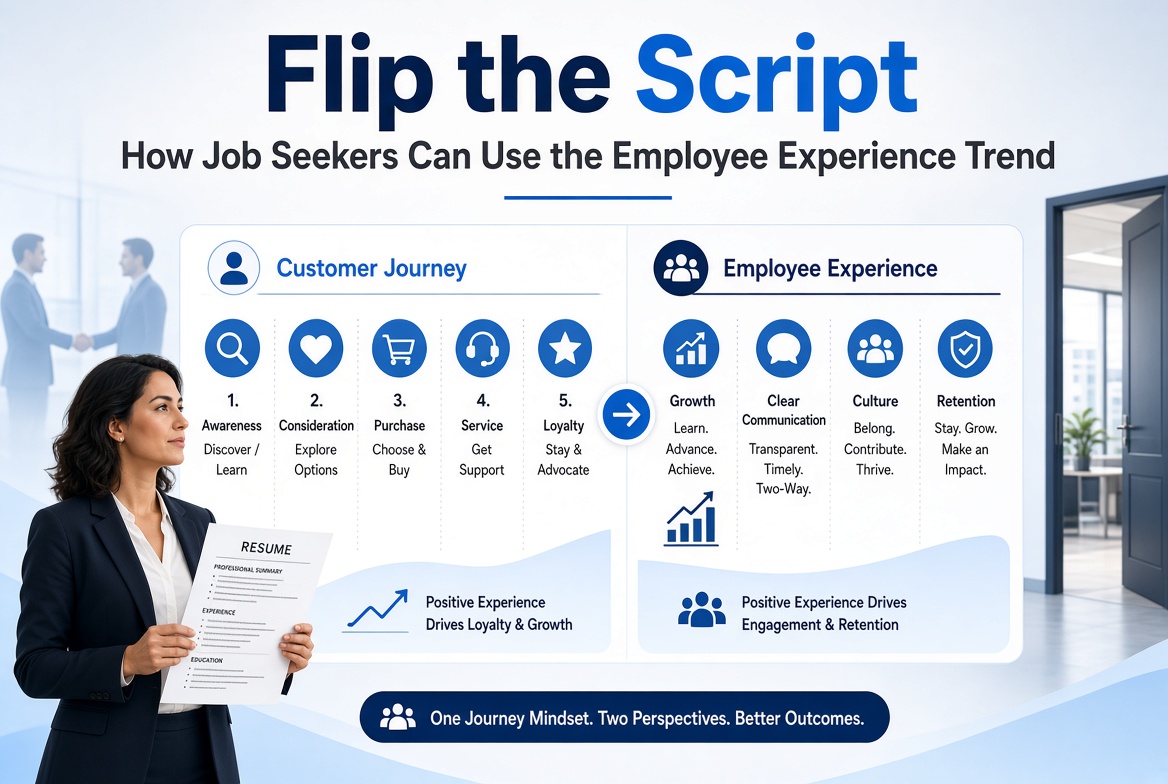 There's a growing trend in HR circles: treating employees with the same care and attention that companies give their best customers. The idea is that if a company maps out the employee experience the way it maps a customer journey, it ends up with better retention, stronger culture, and people who actually want to show up.
That's great news for employees already inside those companies. But if you're on the outside, staring at a job posting and wondering whether this employer is worth your time, that same framework is incredibly useful.
Here's how to flip it around and use it during your job search.
Ask: Does This Company Actually Know What It's Offering?
Companies that treat employees like customers do the work of understanding what people need, not just what the job description says. They have a clear "employee value proposition" the same way a brand has a product promise.
When you're researching a role, look for signs that the employer has actually thought this through:
- Is the job posting specific about growth opportunities, or does it just say "fast-paced environment"?
- Do Glassdoor or Blind reviews mention consistent themes (good or bad)?
- Does the company talk about its culture with real examples, or just buzzwords like "innovative" and "collaborative"?
Vague job postings often signal vague employers. A company that knows what it's offering will say so clearly.
Use Your Application to Speak Their Language
One thing customer-focused companies are great at is personalization. They don't send the same message to every customer. They segment, they tailor, they make you feel seen.
You should do exactly that with every application.
A resume blasted to 50 jobs without any changes is the equivalent of a company sending the same generic email to every customer segment. It doesn't work. Tailoring your resume to each job description, specifically matching your skills and bullet points to what the employer actually listed, is how you get noticed.
This is where tools like the skill-weighted match score in Past the Bots come in handy. You paste the job description, and it shows you which keywords you're hitting, which ones you're missing, and whether any of those gaps are potential knockout factors. It takes the guesswork out of "am I speaking their language?"
The goal is to make the recruiter feel like your resume was written specifically for them. Because ideally, it was.
Watch for Red Flags in the Interview Process Itself
Companies that treat employees like customers obsess over the onboarding and candidate experience. How a company treats you during the interview process is a preview of how it will treat you as an employee.
Pay attention to:
- Communication speed and clarity. Do they follow up when they say they will? Are instructions clear?
- Who you meet. Do they introduce you to potential teammates, or just HR and a hiring manager reading from a script?
- How they talk about the role. Are they honest about challenges, or is everything suspiciously perfect?
- The questions they ask. Are they curious about you as a person, or just checking boxes?
A company that genuinely values employees will show curiosity about who you are, not just whether you have the right certifications.
Your Resume Is a First Impression, Not Just a Document
Customer-obsessed companies care deeply about first impressions. Every touchpoint matters, from the first ad a customer sees to the unboxing experience.
Your resume is your first touchpoint. If an ATS mangles it before a human even sees it, you've lost before you started. A clean, single-column, ATS-safe format makes sure the content you worked hard on actually gets read.
It's also worth running your resume through an ATS audit before you apply anywhere. Knowing that your name, contact info, and key skills are being parsed correctly is basic hygiene at this point, the same way a company would QA its website before launch.
The Bigger Takeaway
The companies that treat employees like customers are building workplaces where people feel valued, heard, and invested in. Those are the places worth working for.
Your job during a search is to find them, and to show up looking like someone they'd genuinely want on the team.
That means doing your research, tailoring your materials, paying attention to how the process feels, and making sure your resume actually makes it through the door in one piece.
None of that is revolutionary. But doing all of it consistently is rarer than you'd think, and that's exactly what sets strong candidates apart.