What Recruiters See That You Don't: The Hidden World of Bulk Screening
September 17, 2026 · 4 min read · Past the Bots
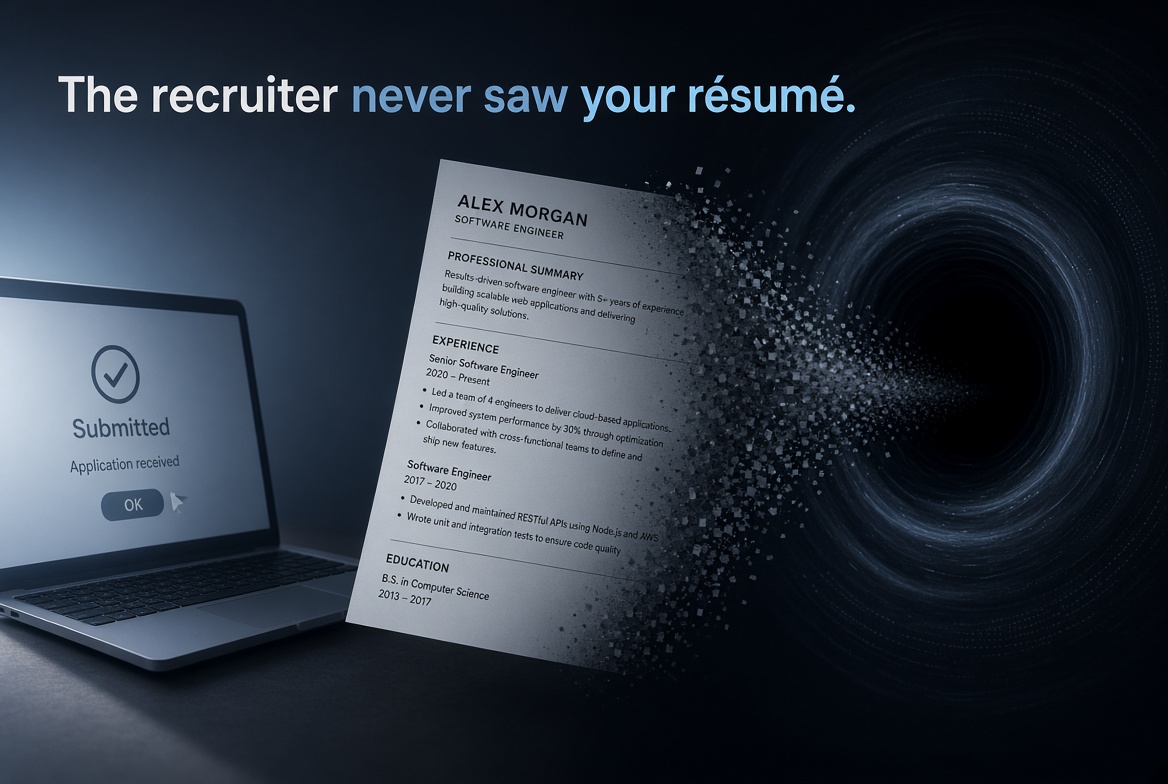 You spent three hours perfecting your résumé. You hit submit, felt a small rush of hope, and then... silence. No callback, no rejection email, just a void.
Here's the part nobody tells you: the recruiter may never have seen your résumé at all.
What a Recruiter's Inbox Actually Looks Like
For any moderately popular job posting, a corporate recruiter can receive 200 to 500 applications within the first 48 hours. For a well-known company or a remote role? Easily over 1,000. There is no universe in which one person reads all of those carefully.
So the Applicant Tracking System does the first pass. It parses every résumé, extracts data into structured fields, and ranks or filters candidates based on how well their information matches what the recruiter told it to look for. By the time a human opens a queue, the list has often been cut by 60 to 80 percent.
The recruiter isn't being lazy. They're triaging. And the ATS is their triage tool.
Where Good Candidates Fall Through the Cracks
The brutal irony is that ATS filtering isn't actually that smart. It's systematic, but systematic in a rigid way. Here are some of the most common reasons a qualified candidate gets quietly dropped:
- Parsing failures on creative formatting. Two-column layouts, text boxes, headers inside tables, and graphics can cause an ATS to misread or completely skip sections. Your contact info might end up in the skills field. Your job titles might disappear entirely.
- Keyword mismatches. You wrote "client relations" and the job description says "account management." To a human, those overlap heavily. To many parsers, they're different strings.
- Missing section labels. Some systems look for specific heading words like "Work Experience" or "Education." If your résumé says "Where I've Been" or uses an unconventional structure, the ATS may not categorize the content correctly.
- Knockout questions answered wrong. Many systems filter on hard requirements like specific certifications, years of experience, or location before a human ever weighs in.
None of these failures mean you aren't qualified. They mean your résumé didn't survive a machine's first read.
The Recruiter's Frustration Too
Here's something worth knowing: recruiters don't love this system either.
A good recruiter's job is to find the best person for a role, and false rejects make that harder. When the ATS filters out a strong candidate because of a formatting quirk or a synonym mismatch, the recruiter doesn't know what they're missing. They only see the list that's left.
Some recruiters manually search the full applicant pool using keyword searches when a role is hard to fill. But that's extra work, it's inconsistent, and it depends entirely on whether your résumé contains the exact strings they're searching for.
The system creates friction for both sides. Job seekers don't get fair consideration. Recruiters don't always get the best candidates. Nobody wins.
What You Can Actually Do About It
The good news is that once you understand how parsing works, you can make deliberate choices that dramatically improve your odds.
Start with a clean structure. Single-column, standard fonts, clear section headings, no text boxes or tables. This sounds boring, but it's what parsers were designed to read. The ATS-safe résumé rebuild in Past the Bots, for example, restructures your content into a format that survives even older or finicky systems.
Mirror the job description's language. You don't need to stuff keywords in awkwardly. Just make sure the words you use reflect how the role is actually described. If the posting says "cross-functional collaboration," use that phrase somewhere if it genuinely applies to your experience.
Check what the parser actually extracts. This is where most people are flying blind. Tools like Past the Bots show you exactly what an ATS pulls out of your résumé: your name, contact info, skills, job titles, dates. Seeing that your phone number ended up in the wrong field, or that a whole job was missed, is the kind of specific feedback that actually helps you fix things.
Close real skill gaps, not imaginary ones. A match score against the job description can show you which required skills are genuinely missing from your résumé versus which ones are just phrased differently. Those are two very different problems with two very different solutions.
The Bottom Line
Recruiters are not the enemy. Neither, really, is the ATS. The problem is a mismatch between how résumés are often written and how they're being read.
Understanding the recruiter's side of the screen doesn't just make you feel better about getting ghosted. It gives you a clear, fixable target. And a résumé that survives the first pass is the only one that gets a real shot.