When High Earners Walk Away: What Their Stories Actually Teach the Rest of Us About Career Pivots
October 3, 2026 · 4 min read · Past the Bots
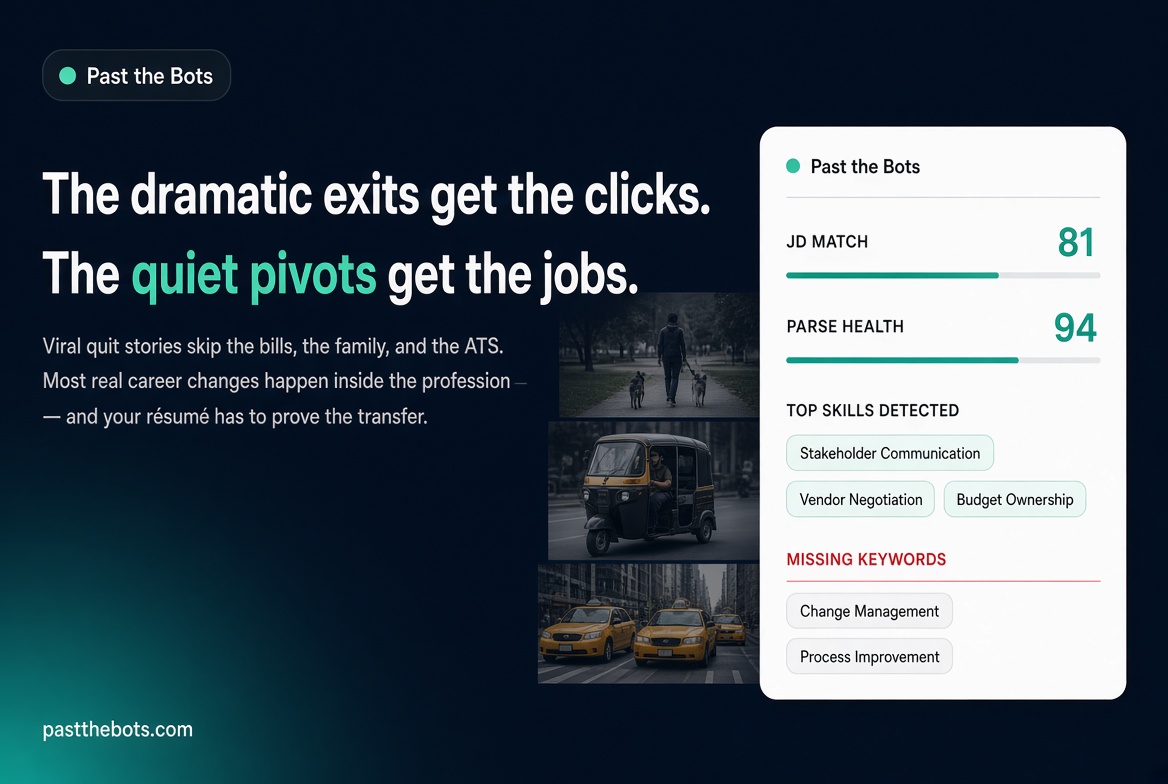 You've probably seen the headlines. A six-figure criminal lawyer who quit to walk dogs. An IT manager who ditched his desk job to operate an auto-rickshaw. An MBA who turned down corporate offers to build a small cab fleet. Each story gets shared thousands of times, framed as a freedom narrative, a middle finger to the grind, proof that the "system" is optional.
And honestly? Good for them. These are real people making real choices.
But here's what those viral posts leave out: the part where you still have bills, a mortgage, or a family depending on your income. The part where walking away from your field without a plan can set you back years. The part where the corporate ladder, annoying as it is, also funds retirement accounts and health insurance.
So instead of just celebrating or dismissing these stories, let's pull out what's actually useful for the rest of us who are grinding through job searches, considering pivots, or wondering if the career we built is still the one we want.
The Real Lesson: They Knew Exactly What They Were Leaving
The lawyers and IT managers who go public with dramatic exits almost always share one thing in common: they had deep clarity about what their old life cost them, not just what it paid them.
That's genuinely worth borrowing. Before you pivot, it helps to get honest about what your current path is actually costing you in time, autonomy, and energy. That clarity becomes the foundation of a pivot that's intentional rather than reactive.
Most of Us Are Pivoting Within, Not Away
Here's the thing the viral stories don't capture: most career pivots aren't dramatic exits. They're lateral moves, industry shifts, or role changes that happen inside the professional world. A software engineer moving into product management. A teacher transitioning into instructional design. A paralegal stepping into HR compliance.
These pivots are harder to make compelling on LinkedIn, but they're far more common and often far smarter financially.
And they come with a specific challenge: your resume has to do extra work.
When you stay in your field, a hiring manager reads your resume and nods along. When you pivot, they squint. They're looking for evidence that your old skills translate, and an ATS is doing the same thing, often before a human ever sees your application.
What Happens to a Pivot Resume Inside an ATS
Applicant Tracking Systems don't read context. They don't know that your decade managing IT infrastructure makes you an excellent candidate for an operations role. They scan for keywords, section headers, and structured data. If your resume was built for your old career, it will underperform against job descriptions in your new one, sometimes badly.
A few things that trip up career-pivoters specifically:
- Skills buried in the wrong sections. Transferable skills like project management, stakeholder communication, or data analysis often show up in your bullets but don't get flagged as skills because they're not in a dedicated skills section.
- Job titles that don't map to the new field. "Senior Network Engineer" and "IT Operations Manager" can mean similar things, but ATS parsers treat them differently when matching against a posting for "Infrastructure Director."
- Missing keywords from the target job description. You might have done the work, but if you didn't use the words the job posting uses, the system won't make the connection.
This is where running your resume through an ATS scan before you apply becomes genuinely useful rather than just a nice-to-have. Tools like the one on Past the Bots show you exactly what a parser extracts from your document and how well it matches a specific job description, including which keywords are missing and which ones are landing.
Rewriting for a Pivot Without Making Things Up
One thing that makes pivoters nervous is rewriting their resume for a new field without feeling like they're misrepresenting themselves. That's a legitimate concern.
The answer isn't to fabricate. It's to reframe accurately. The same project that made you a great IT manager probably also made you a great cross-functional communicator, budget owner, and vendor negotiator. Those are real, and they belong on the page in language the new field recognizes.
AI tailoring tools, when done responsibly, help you find that language without inventing experience that isn't there.
So Should You Walk Away?
Maybe. But "I saw a lawyer become a dog walker and it looked freeing" is not a career strategy.
What those stories are actually good for is permission: permission to question what you've built, to ask whether the next twenty years need to look like the last ten, and to take a pivot seriously enough to plan it properly.
The dramatic exits get the clicks. The quiet, well-executed pivots get the jobs.