Where the Jobs Actually Are in 2006 (And What That Means for Your Search)
September 29, 2026 · 4 min read · Past the Bots
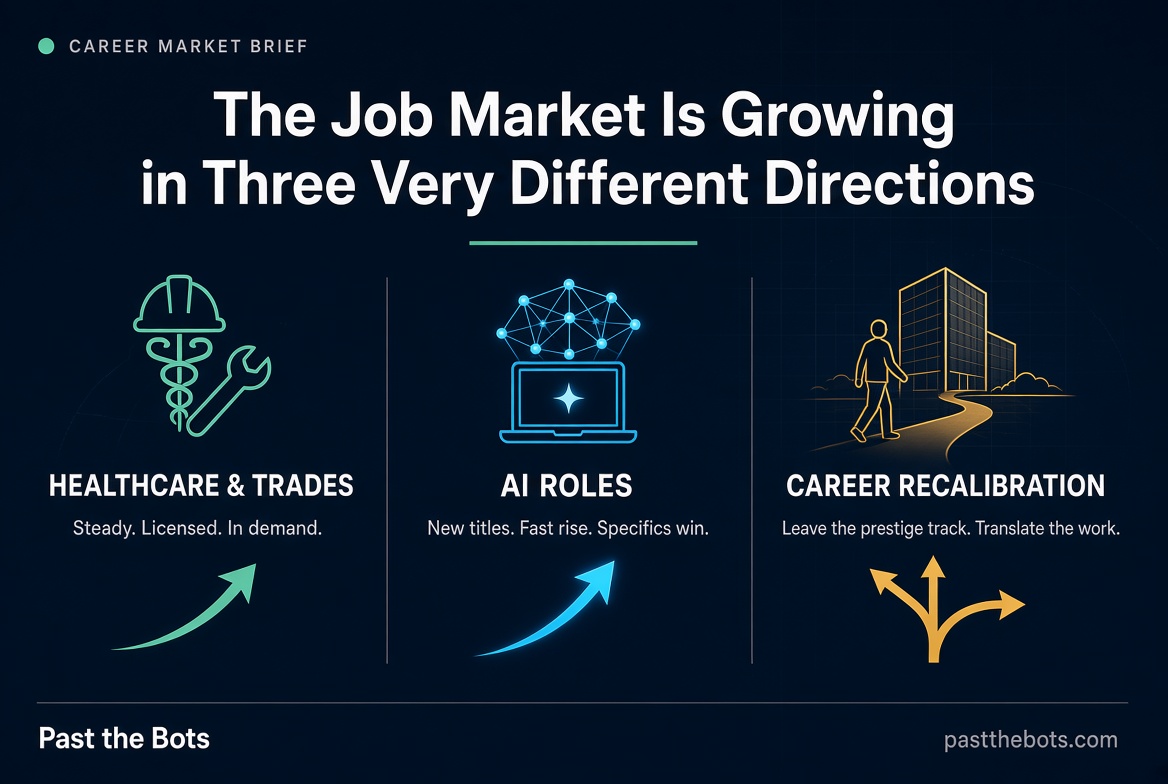
The Job Market Is Growing in Three Very Different Directions
If you've been watching hiring news lately, you might feel like you're getting three contradictory signals at once. AI is eating jobs. AI is creating jobs. Trades are booming. Healthcare can't hire fast enough. Which story is actually true?
Honestly? All of them, in different corners of the market. Here's what's really happening and, more importantly, what it means for how you position yourself.
Healthcare and Trades: Slow and Steady Wins the Race
If you want reliable, recession-resistant growth, healthcare and the physical trades are the most consistent story in hiring right now. These aren't flashy sectors, but they're where the volume is.
On the healthcare side, demand is being driven by an aging population and a persistent shortage of workers at almost every level, from home health aides to surgical techs to nurse practitioners. These roles rarely disappear into a layoff announcement.
The trades tell a similar story. Electricians, HVAC technicians, pipefitters, and construction managers are in genuinely short supply. Infrastructure spending, the reshoring of manufacturing, and a decade of underinvestment in vocational training have created a gap that isn't closing anytime soon.
What this means for your résumé: Both sectors rely heavily on certifications, licenses, and specific equipment or software experience. Make sure those credentials are front and center, spelled out clearly, not buried in a paragraph. ATS parsers scan for exact matches, so "Licensed Journeyman Electrician" should appear verbatim if that's what the job posting says.
AI Roles: The Fastest-Rising Titles in the Game
On the other end of the spectrum, AI-adjacent roles are exploding in title diversity. Prompt Engineer, AI Product Manager, Machine Learning Operations Engineer, AI Trainer, LLM Fine-Tuning Specialist -- these titles barely existed three years ago and now they're some of the most searched on LinkedIn.
The catch? The job descriptions are all over the place. Two postings with the same title can require completely different skill sets. And because these roles are new, a lot of applicants are trying to claim them without having the substance to back it up.
What this means for your résumé: Be specific about what you actually did. "Used AI tools to improve workflow" doesn't cut it. "Reduced content review time by 40% by building a GPT-4-based classification pipeline" does. Specificity is what separates people who are actually doing the work from people who are keyword-stuffing their way through screening.
If you're pivoting into AI from an adjacent field, lean into the transferable depth you already have. A data analyst who understands business context and can prompt meaningfully is genuinely valuable. Just make sure your résumé reflects that story clearly.
The Underground Story: Escaping the Traditional Pipeline
Here's the job market trend that doesn't show up in official reports but shows up constantly in the stories people share: a lot of talented people are actively choosing to leave prestige tracks.
Ex-consultants going independent. Former tech managers going back to hands-on roles. People trading a corner-office trajectory for autonomy, predictability, or just actual work they care about. It's not burnout panic -- it's a deliberate recalibration.
If this is you, your résumé challenge is a specific one: you need to translate high-status but vague experience into concrete, relevant value for a new audience. A Director of Strategy title means almost nothing to a regional healthcare network hiring an operations manager. What did you actually do? How many people, how much budget, what kind of decisions?
Rewriting for a career shift is also where AI tailoring tools can genuinely help. The goal isn't to fabricate anything -- it's to reframe real experience in the language the new employer actually uses. That's a legitimate and important skill, and it's worth putting real effort into.
Three Practical Things to Do Right Now
Regardless of which growth area you're targeting, these moves apply across the board:
- Run your résumé against the actual job description before you apply. A skill-match scan will show you which keywords you're hitting and which critical gaps might be costing you interviews.
- Check what an ATS actually extracts from your file. Formatting issues like tables, headers in text boxes, or unusual fonts can cause parsers to misread your name, drop your contact info, or skip entire sections.
- Tailor the bullets, not just the summary. Most people swap out the objective statement and call it a day. The real work is in making your experience bullets reflect the language of the specific role.
The job market isn't one story. It's three or four running in parallel. The good news is that knowing which one you're in makes it a lot easier to run the right race.