Why a 'Perfect' Résumé Can Actually Raise Red Flags (And What to Do Instead)
August 14, 2026 · 4 min read · Past the Bots
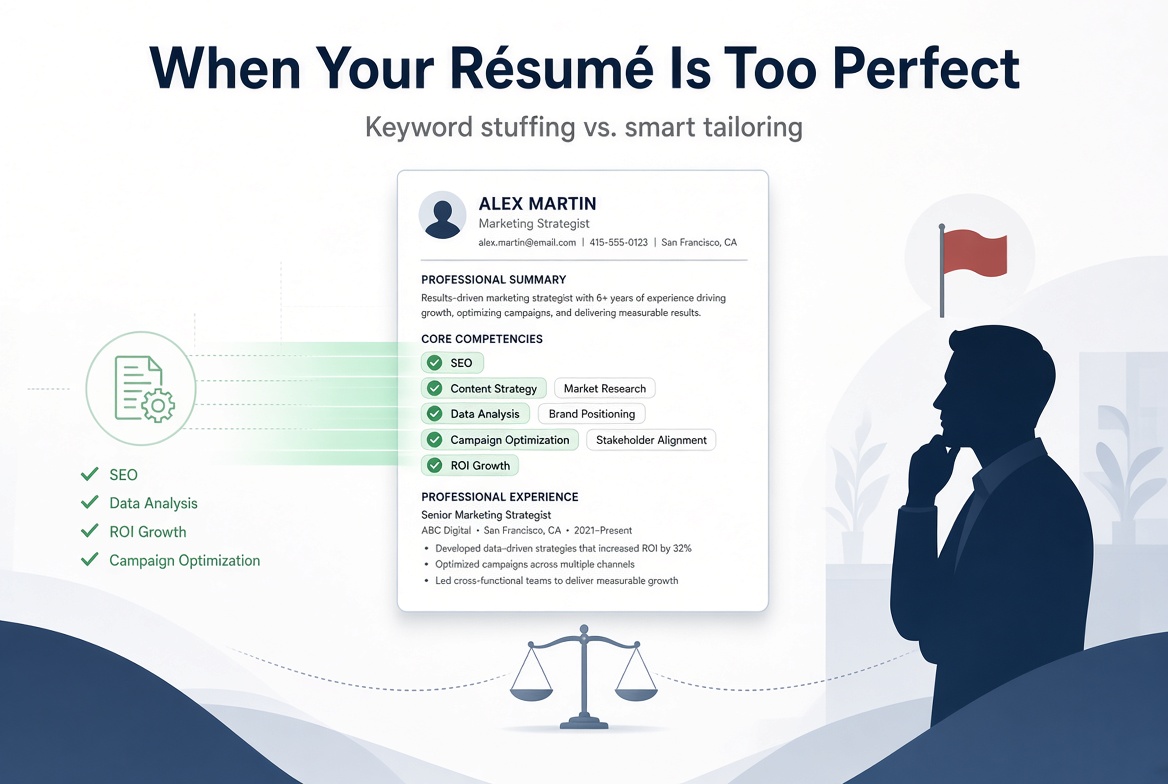 You spent hours tailoring your résumé to a job posting. You mirrored the exact language. You hit every keyword. Your match score looked great. And then... silence.
Here's something uncomfortable that's worth knowing: hiring managers are increasingly flagging résumés that look too perfect as a potential red flag. A recent piece making the rounds reported that recruiters are growing skeptical when a candidate's résumé reads almost like a copy-paste of the job description itself. It signals to them that you may have over-optimized for the algorithm rather than authentically representing your experience.
So now you're stuck between two problems. Ignore keywords and the ATS buries your résumé before a human ever sees it. Over-stuff keywords and the human who does see it thinks you're gaming the system. Fun, right?
The good news: this is a solvable problem, and it comes down to understanding what "tailoring" actually means.
The Difference Between Keyword Stuffing and Smart Tailoring
Keyword stuffing is dropping terms from a job description directly into your résumé with no real context. "Managed cross-functional stakeholder alignment" appears in the job posting, so it appears in your résumé, even if you'd describe what you actually did very differently.
Smart tailoring is different. It means:
- Using the right terminology for skills and tools you genuinely have, because different companies use different words for the same things
- Reframing real accomplishments in language that maps to what this employer cares about
- Leading with relevant experience so the reader immediately sees the connection
- Not padding with responsibilities or skills that are a stretch
The goal is clarity and relevance, not mimicry. A hiring manager should read your résumé and think "this person clearly has this background" not "this résumé was clearly written to fool a scanner."
Why ATS Optimization Still Matters (Just Not in the Way You Think)
Here's the thing: you still need to clear the ATS. Most mid-to-large employers use applicant tracking systems that parse and score résumés before a recruiter ever opens one. If your formatting breaks the parser or your skills are described in ways the system doesn't recognize, you're out before you're in.
But the ATS isn't looking for keyword density. It's looking for presence and context. Did you list the skill? Does it appear in a logical section? Is your résumé even readable by the parser in the first place?
This is exactly where tools like Past the Bots can help you thread the needle. The ATS scan shows you exactly what a system extracts from your résumé: your name, contact info, skills, and section headers. If something critical is missing or misread, you'll see it flagged before you apply. That's the kind of fix that gets you past the bots without resorting to stuffing.
The skill match feature is worth using carefully too. When you paste in a job description and see which keywords you're missing, that's not a shopping list to copy into your résumé wholesale. It's a diagnostic. For each gap, ask yourself: do I actually have this skill or experience? If yes, find the right place to surface it authentically. If no, leave it out.
Let AI Rewrite, Not Fabricate
One of the more useful things you can do when tailoring is have your existing bullets rewritten to better reflect relevant accomplishments without changing what actually happened. Past the Bots has an AI tailoring feature built specifically for this: it rewrites your bullet points to align with a target job, but it works from what you've already written. It's not inventing experience. It's just helping you say what you actually did in language that lands better for this particular role.
That's the distinction that matters. A résumé that reads naturally and still hits the right notes is far more compelling than one that feels like it was assembled by an algorithm.
The Bottom Line
Hiring managers are smart. They've seen thousands of résumés and they know when something feels off. The job seekers who stand out right now are the ones whose résumés feel genuine AND are formatted cleanly enough to survive the ATS.
That means:
- Fix your formatting so parsers can actually read your résumé
- Match keywords you legitimately own, not every keyword in the posting
- Let your real accomplishments do the heavy lifting, in clear, specific language
- Skip the fluff that pads a résumé but adds no signal
The bots and the humans both need to say yes. You can make that happen without tricking either of them.