Why Cybersecurity Jobs Go Unfilled (And How to Make Sure Yours Gets Noticed)
October 1, 2026 · 4 min read · Past the Bots
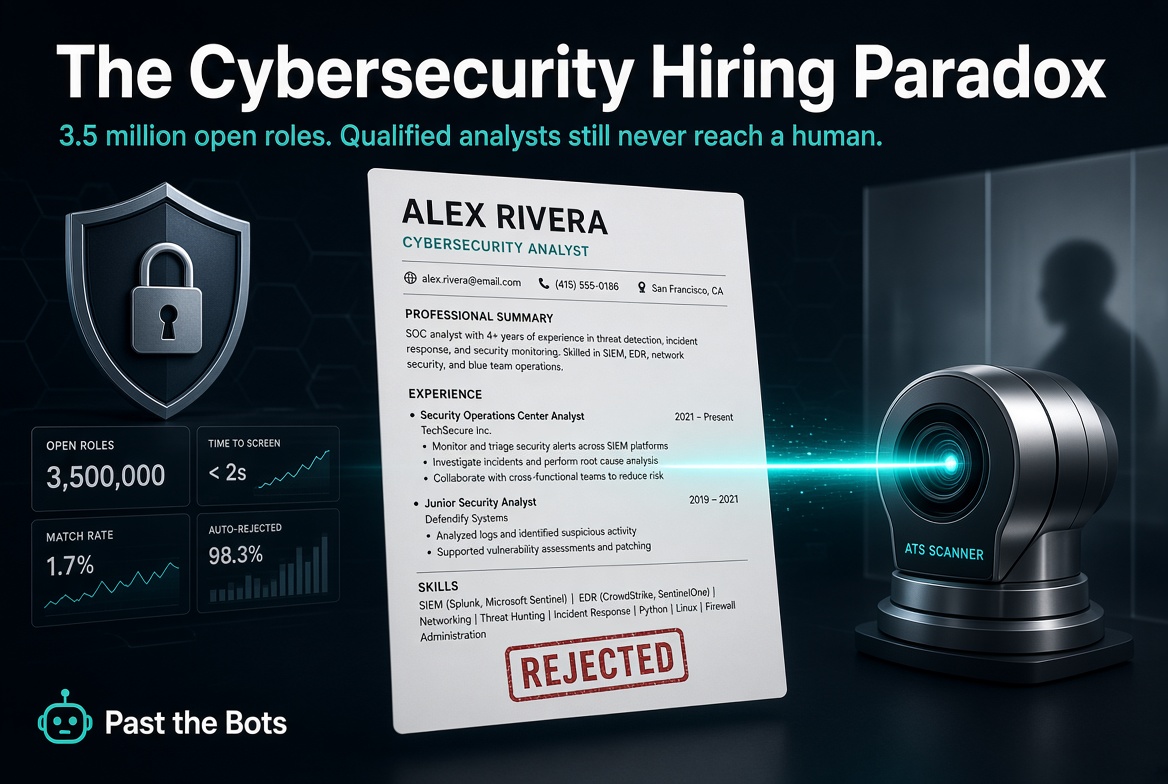
The Cybersecurity Hiring Paradox
Here's something that should not make sense: cybersecurity is one of the most in-demand fields on the planet, with an estimated 3.5 million unfilled positions globally, and yet talented analysts still struggle to land interviews.
How does that happen?
A big part of the answer is the same automated screening that trips up job seekers in every industry. Companies post security roles, get flooded with applications, and lean on Applicant Tracking Systems to filter them down to a manageable shortlist. If your resume doesn't speak the right language, you get filtered out before a human ever reads a word you wrote.
The good news: the talent gap is real, hiring managers are genuinely motivated to fill these seats, and a little resume optimization goes a long way in a field where most candidates aren't thinking about it.
Why Security Resumes Get Rejected by ATS
Cybersecurity professionals often have rich, complex experience that is genuinely hard to summarize. The work involves deep technical knowledge, certifications, compliance frameworks, and constantly evolving toolsets. That complexity can actually work against you when a parser is scanning your resume.
A few common problems:
- Certification abbreviations without the full name. ATS parsers aren't always smart enough to know that CISSP means Certified Information Systems Security Professional. Write both.
- Tool names buried in paragraphs. If Splunk, Wireshark, CrowdStrike, or Tenable are mentioned once inside a dense block of text, parsers may miss them entirely.
- Fancy formatting. Tables, text boxes, and multi-column layouts look polished in PDF but cause parsers to scramble or skip content altogether.
- Generic section headers. Calling your certifications section "Credentials" or "Achievements" instead of "Certifications" can confuse the system.
- Missing keywords from the job description. Even if you have the experience, if the posting says "threat hunting" and your resume says "proactive threat detection," an ATS may not connect the dots.
The Certifications and Skills Problem
Security roles are heavily certification-driven. CISSP, CEH, CompTIA Security+, CISM, OSCP, and dozens of others carry real weight with hiring managers. But they only count if the ATS actually extracts them correctly.
The safest approach is to create a dedicated Certifications section near the top of your resume and list each one in full, like this:
- Certified Information Systems Security Professional (CISSP)
- Offensive Security Certified Professional (OSCP)
- CompTIA Security+ (SY0-701)
Then list your tools and technologies separately in a Technical Skills section, broken out by category if possible. Something like:
- SIEM: Splunk, IBM QRadar, Microsoft Sentinel
- Endpoint: CrowdStrike Falcon, Carbon Black, SentinelOne
- Vulnerability Management: Tenable Nessus, Qualys, Rapid7
- Frameworks: NIST CSF, MITRE ATT&CK, ISO 27001
This kind of structured layout is not just good for parsers. It is also much easier for a hiring manager to scan quickly during a 30-second review.
Match Your Resume to Each Posting
Security job titles are famously inconsistent. One company's "SOC Analyst" is another's "Cyber Threat Analyst" or "Information Security Specialist." The responsibilities can be nearly identical, but the ATS is matching on specific keywords from that specific job description.
Before you apply, paste the job description into a tool that shows you the keyword match between the posting and your resume. You want to see which required skills are missing from your document and which ones are already covered. Then close those gaps by working the missing terms naturally into your bullets.
For example, if the posting mentions "incident response lifecycle" and your resume only says "managed security incidents," update the language to reflect the terminology the employer actually used.
Past the Bots does exactly this kind of skill-weighted match analysis, showing you matched keywords, missing keywords, and anything that looks like a knockout gap. It takes about two minutes and usually surfaces at least a few quick wins.
Write Bullets That Show Impact, Not Just Duties
Once your resume gets past the ATS, it still has to impress a person. Security hiring managers see a lot of resumes that read like job descriptions. Yours should read like an accomplishment record.
Instead of: Monitored SIEM alerts and escalated incidents.
Try: Triaged an average of 200 daily SIEM alerts, reducing mean time to escalation by 40% through improved runbook documentation.
Numbers, context, and outcomes do the heavy lifting here. Even approximate figures are better than none.
The Bottom Line
The cybersecurity talent gap means opportunities are genuinely out there. Companies need to fill these roles badly. Your job is to make sure your resume clears the automated hurdle so a real person can evaluate what you actually bring to the table. Clean formatting, structured skills, matched keywords, and impact-focused bullets will get you much further than experience alone.