You Already Have These In-Demand Skills. Here's How to Prove It on Your Résumé.
November 22, 2026 · 4 min read · Past the Bots
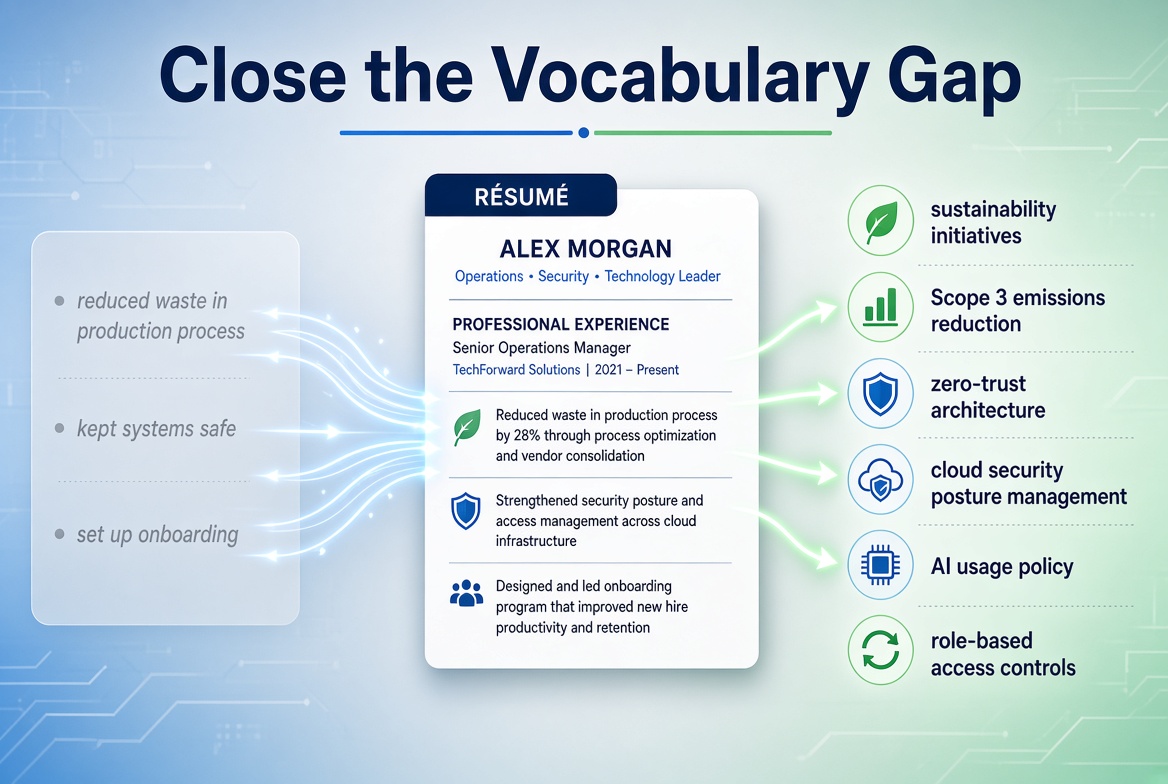 Hiring managers are hunting for people with green skills, AI security experience, and the ability to adapt fast. Meanwhile, you've been doing that work for years under different names.
The problem isn't your experience. It's the vocabulary gap between what you've been calling your work and what the systems screening your résumé are trained to look for.
Here's how to close that gap without overstating a thing.
Why This Vocabulary Gap Exists
ATS tools and the recruiters who use them search for specific terms. If your résumé says "reduced waste in the production process" but the job posting says "sustainability initiatives" or "Scope 3 emissions reduction," the system may not connect those dots. Same goes for security work described as "kept systems safe" versus "cloud security posture management" or "zero-trust architecture."
You don't need new experience. You need to rename what you already did using the language your audience is searching for.
The Self-Audit: Questions to Ask Yourself
Go through these before you touch a single bullet point. Answer honestly, even if the work feels routine to you.
For green and sustainability skills:
- Did you ever reduce energy use, materials, or waste in any process, even by accident?
- Have you worked on supply chain decisions where vendor environmental practices came up?
- Did you track, report, or reduce any kind of organizational footprint (travel, paper, energy, packaging)?
- Have you worked with any ESG reporting, carbon accounting tools, or sustainability frameworks?
For AI and security skills:
- Have you evaluated, implemented, or audited any AI tools for your team or company?
- Did you ever write policies, guidelines, or guardrails for how people should use technology?
- Have you worked on data governance, access controls, or compliance programs?
- Did you assess vendor risk, review third-party software, or manage credentials and permissions?
For adaptability and change skills:
- Have you led or survived a major system migration, reorg, or pivot?
- Did you train colleagues on new tools or processes?
- Have you built something from scratch with no playbook, or stepped into a role that didn't have a job description yet?
- Have you managed projects or teams through uncertainty, budget cuts, or shifting priorities?
If you answered yes to any of these, you have skills worth surfacing. Now let's rewrite them.
Before and After: Real Rewrites
Cloud / Ops professional with security work:
Before: Managed access to internal systems and made sure only the right people had the right permissions.
After: Administered role-based access controls (RBAC) across cloud infrastructure; reduced unauthorized access incidents by 40% through quarterly permission audits aligned with zero-trust principles.
The experience is identical. The second version speaks the language a security-focused ATS and hiring manager will recognize.
Product manager with AI governance work:
Before: Helped the team figure out how to responsibly use AI tools in our workflow.
After: Developed internal AI usage policy for a 20-person product team, defining acceptable use cases, data handling rules, and human-review requirements for AI-generated outputs.
This signals AI literacy and risk awareness, two things companies are actively hiring for right now.
Operations or supply chain person with sustainability exposure:
Before: Worked with vendors and helped cut shipping costs.
After: Renegotiated logistics contracts with three suppliers, reducing ground shipping miles by 18% and contributing to the company's annual carbon footprint reduction goals.
You don't need to have been a sustainability lead to have done sustainability work.
Someone who built a new process from nothing:
Before: Set up the onboarding process for a new department.
After: Designed and implemented onboarding program for a newly formed 12-person team during a company restructure, cutting ramp-up time from 8 weeks to 5 weeks with no existing documentation to work from.
That last phrase, "no existing documentation," is what signals adaptability. Don't hide it.
A Practical Next Step
Once you've rewritten your bullets, run your résumé against the actual job description you're applying to. The skill-match scan in Past the Bots will show you which keywords landed and which ones are still missing, so you can see exactly where the vocabulary gap remains before the application goes out.
The goal isn't to stuff in buzzwords. It's to make sure the work you've genuinely done gets recognized by the systems standing between your résumé and a human's inbox.
You did the work. Make sure your résumé says so in a language that gets heard.