Your Posture Is Suffering at Your Desk. So Is Your Job Search.
July 27, 2026 · 4 min read · Past the Bots
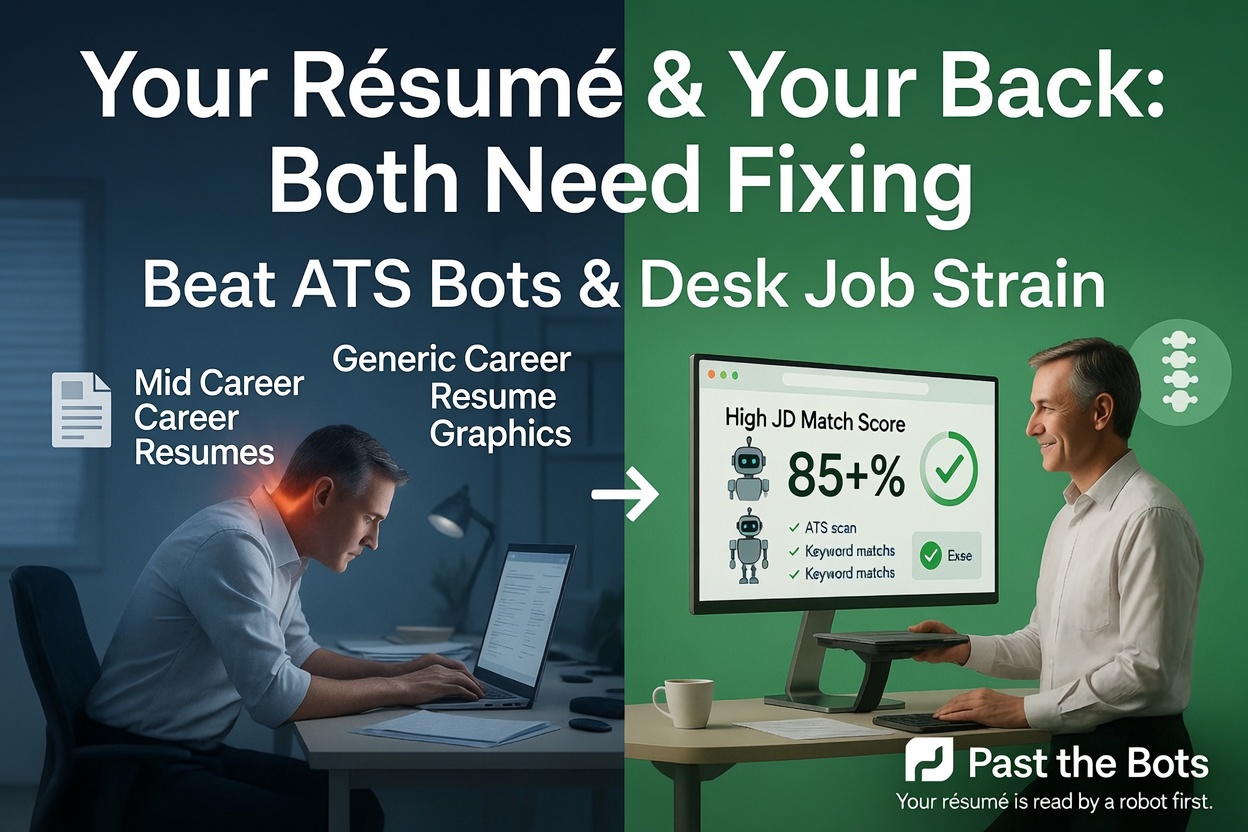 If you've spent the last few weeks hunched over your laptop, refreshing job boards and copy-pasting your résumé into application portal after application portal, your body already knows it. Neck tight. Shoulders rounded. Lower back quietly furious.
A recent report from health and workplace experts confirms what most of us feel but ignore: desk jobs and sedentary daily habits are driving a real increase in posture-related problems. Long hours of sitting, screens at the wrong height, and the kind of low-grade stress that comes with job searching all compound the problem.
Here's the thing, though. The same habits that are hurting your posture are probably hurting your job search, too.
The Job Search Grind Is Its Own Kind of Strain
Most job seekers are applying the same way they've always applied: open a résumé, tweak a word or two, upload, repeat. It's repetitive, it's exhausting, and it rarely works as well as it should.
Applicant Tracking Systems (ATS) are the automated gatekeepers that scan your résumé before a human ever sees it. If your file doesn't parse cleanly, if your skills don't match the job description's keywords, or if your formatting confuses the software, you're filtered out before anyone reads a single word you wrote.
Spending hours applying and hearing nothing back is demoralizing. And ironically, the stress of a stalled job search keeps you glued to that chair even longer.
Bad Habits Stack Up Fast
The experts quoted in the MSN piece point to something worth noting: posture problems don't usually come from one catastrophic moment. They come from small repeated habits done wrong, over and over, until the damage adds up.
Your résumé works the same way. A few common problems that quietly kill your chances:
- Two-column layouts look polished in Word but confuse most ATS parsers, which read left to right across the whole page and mix up your job titles with your dates.
- Headers and footers for contact info seem smart for design, but many parsers skip them entirely, so your email address never gets extracted.
- Skills buried in paragraph text instead of a dedicated section often go undetected by keyword scanners.
- Generic bullet points like "responsible for managing projects" don't match the specific language a job description uses, so the match score tanks.
None of these feel like big mistakes. But stacked together, they mean your résumé is functionally invisible to the systems deciding who gets an interview.
Small Fixes, Real Results
Just like fixing your posture doesn't require a total lifestyle overhaul (sometimes it's just moving your monitor up three inches), fixing your résumé for ATS doesn't have to be a massive project.
Here's a practical checklist to start with:
- Run your résumé through an ATS scan. Tools like the one on Past the Bots show you exactly what a parser extracts: your name, contact info, skills, and section headers. If something's missing or misread, you'll see it flagged as a critical issue right away.
- Match your language to the job description. Pull the exact phrases from the posting and work them into your résumé where they genuinely apply. A skill-gap tool that shows matched versus missing keywords makes this much faster than doing it manually.
- Switch to a single-column layout. It's less flashy, but it parses cleanly. An ATS-safe rebuild prioritizes getting your content read correctly over looking fancy in a format that a bot will never appreciate anyway.
- Rewrite your bullets around impact. Numbers and outcomes beat vague responsibilities every time. "Reduced onboarding time by 30%" is better than "helped with onboarding process."
Take Care of the Whole Picture
While you're at it, do your back a favor too. The MSN piece recommends simple things: stand up every 30 to 45 minutes, set a timer if you need to, adjust your chair so your feet are flat and your screen is at eye level. Even a short walk around the block between applications resets both your posture and your focus.
Job searching is a marathon, not a sprint. Burning yourself out in week two by sitting hunched for eight-hour sessions isn't a strategy. Protecting your energy means you'll bring more focus to the applications that actually matter.
The Takeaway
Your résumé and your back have more in common than you think. Both suffer from accumulated small mistakes, and both benefit enormously from a few targeted corrections applied consistently.
Fix how you sit. Fix how your résumé reads to an ATS. Then go apply with a lot more confidence that what you're sending actually has a real shot.