Your Quirks Are a Career Asset — Here's How to Make Sure the Bots Don't Hide Them
August 11, 2026 · 4 min read · Past the Bots
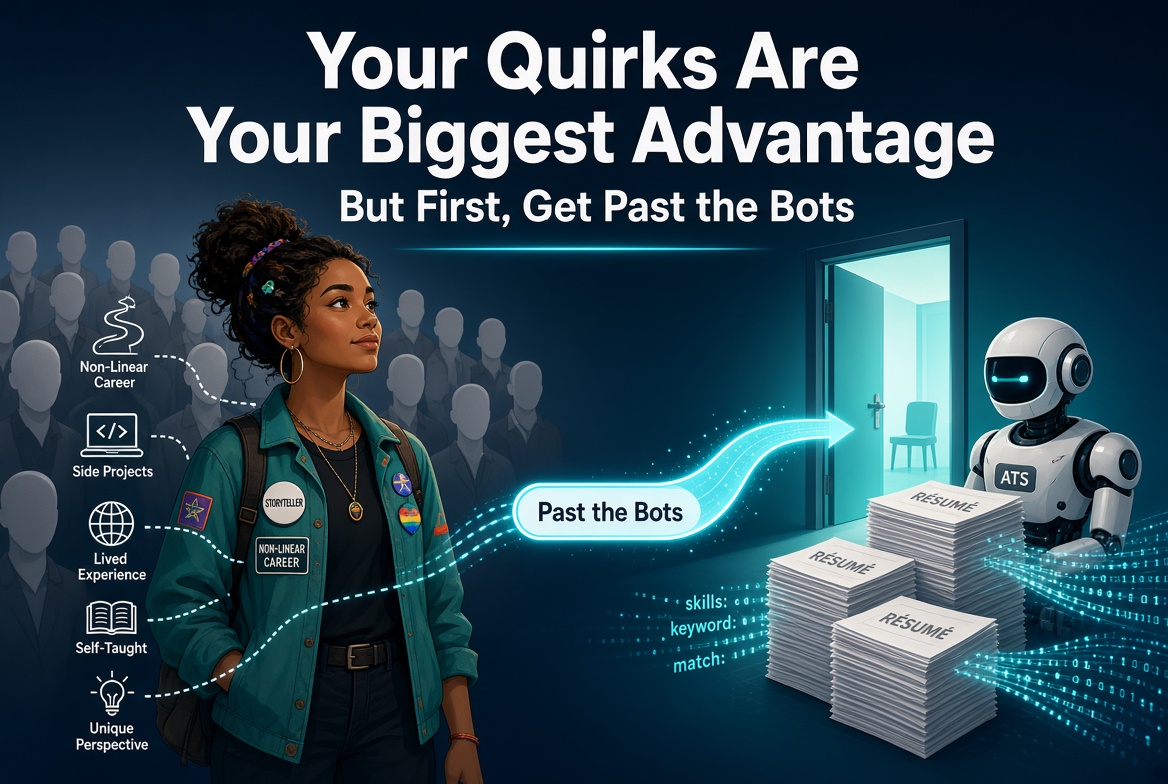 MacKenzie Scott recently made a surprising argument for job seekers: your quirks, the things that make you a little different, might actually be your biggest competitive advantage. In a world obsessed with polished, cookie-cutter candidates, authenticity stands out.
She's right. But there's a catch nobody talks about.
Before a human hiring manager ever gets the chance to appreciate what makes you you, your résumé has to survive an Applicant Tracking System. And ATS software doesn't care about your personality. It cares about keywords, formatting, and whether it can parse your file at all.
So let's talk about how to honor both truths: show up as your genuine self and get past the bots.
Why Authenticity Matters More Than Ever
Scott's point is really about differentiation. When everyone sends the same generic résumé full of phrases like "results-driven professional" and "synergistic team player," the candidates who bring a real perspective cut through the noise.
That could mean:
- A non-linear career path that gave you skills most specialists don't have
- A side project that shows genuine passion for the industry
- A specific, unusual accomplishment that tells a story no one else can tell
- A perspective shaped by lived experience outside the typical corporate ladder
These things are genuinely valuable. The problem is that most people either bury them in vague language or format them in ways that ATS systems mangle beyond recognition.
The Hidden Problem: Your Story Gets Lost Before Anyone Reads It
Here's what actually happens to a lot of résumés. A job seeker puts real effort into capturing their unique background. They use a creative layout, maybe a two-column design or a header with icons. They write honest, specific bullets about what they actually did.
Then the ATS parses it. And suddenly their name is cut off, their skills section is missing, and their best bullet point is sitting in a field labeled "unknown."
A hiring manager never sees the authentic version. They see whatever the ATS could reconstruct, which is often a mess.
This is exactly what Past the Bots' Audit the Bots tool shows you. It runs your résumé through multiple parsers so you can see what different ATS systems actually extract: your name, contact info, skills, and work history sections. If something important isn't showing up correctly, you'll see it flagged as a critical fix before you apply anywhere.
Don't Dumb Yourself Down — Translate Yourself
The answer is not to strip your résumé of everything that makes it interesting. The answer is to make sure your authentic experience is also readable by machines.
A few practical ways to do that:
Use standard section headers. ATS systems look for labels like "Work Experience," "Skills," and "Education." If your header says "Where I've Been" because you thought it sounded more human, the parser may skip the whole section.
Put your keywords in plain text. Skills buried in a graphic, a text box, or a table often disappear during parsing. Write them out in a simple list the system can actually read.
Let your bullets do the storytelling, not your format. A single-column, ATS-safe layout doesn't have to be boring. Strong, specific bullet points that show real results are what make a résumé memorable, not colored sidebars.
Past the Bots' ATS-safe single-column rebuild is designed exactly for this. It keeps your content and your voice, just in a structure that survives the screening process.
Your Quirky Career Path Needs the Right Keywords Too
If your background is non-traditional, you might actually have a keyword problem on top of a formatting problem. Your experience is real and relevant, but you may not be describing it in the language the job posting uses.
That's where a skill-weighted match score against the job description becomes genuinely useful. You can paste the job description and see which keywords you've matched, which ones are missing, and which gaps might be automatic knockouts for that specific role.
The goal isn't to stuff your résumé with buzzwords. It's to make sure the legitimate experience you have is described in language that connects to what the employer is actually looking for.
From there, AI tailoring can help you rewrite your existing bullets to better reflect the job's language, without inventing anything you didn't do. Your quirky, real experience gets surfaced in a way that the system can recognize.
The Bottom Line
MacKenzie Scott is onto something. The candidates who bring something genuine to the table really do stand out. But standing out to a human requires getting there first.
Get your formatting right, make sure your parseable skills match the job, and then let your actual story do the work. That combination, human authenticity plus machine readability, is what actually lands interviews.