Your Résumé Got Compliments But Not Callbacks? Here's Why.
August 15, 2026 · 4 min read · Past the Bots
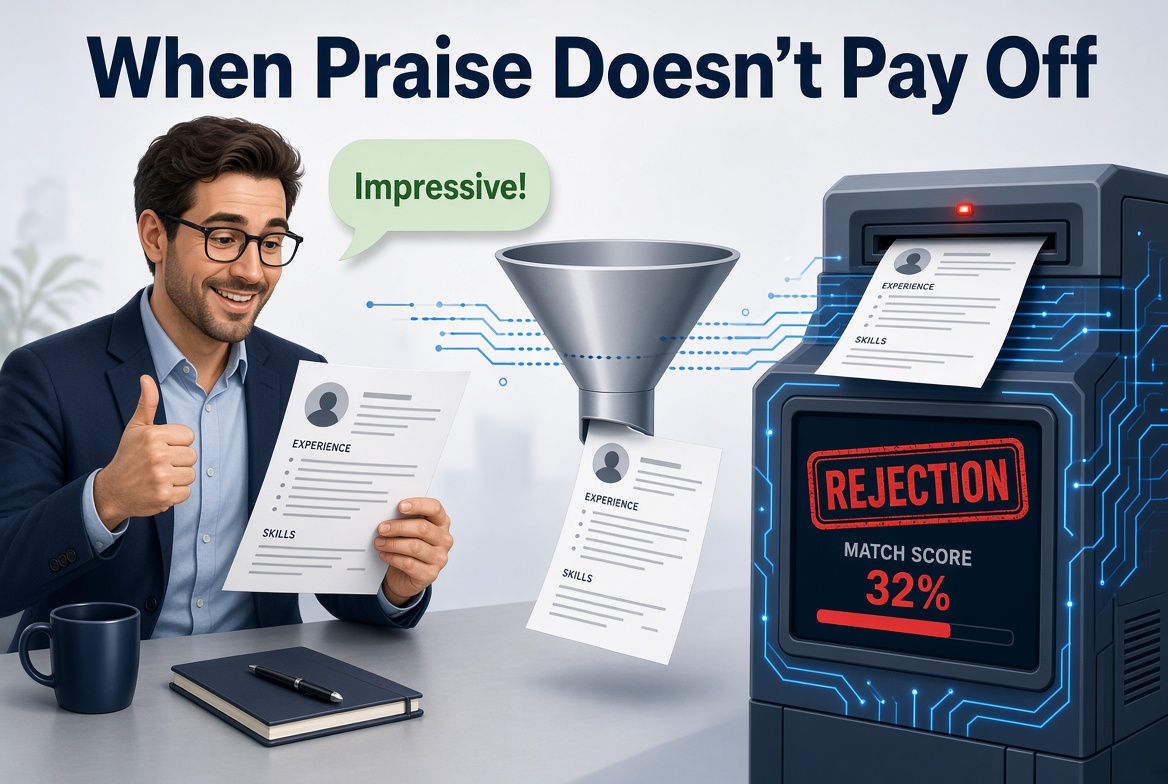
When Praise Doesn't Pay Off
There's a particular kind of job-search heartbreak that doesn't get talked about enough: the recruiter or hiring manager who tells you your résumé is impressive, maybe even exciting, and then you never hear from them again.
A recent story making the rounds captures this perfectly. A job seeker shared how their CV drew genuine praise from a human reviewer, only to receive a rejection email shortly after. No explanation, no feedback, just a polite door-close.
So what happened?
In most modern hiring pipelines, your résumé doesn't go straight to a human. It passes through an Applicant Tracking System first. The ATS parses, scores, and ranks your application before anyone with a pulse lays eyes on it. If the system doesn't extract your information correctly, or if your résumé doesn't score well against the job description, you can drop off the list before the person who would have loved your background ever gets the chance to see it.
Praise from one human doesn't override a low match score from a bot.
What an ATS Actually Does to Your Résumé
This is where a lot of job seekers get tripped up. They think the ATS is just a filing system. It's not. It's actively making decisions about your application.
Here's what's happening behind the scenes:
- Parsing: The ATS pulls your name, contact info, job titles, dates, skills, and education out of your file. If your formatting confuses it, that information gets scrambled or lost entirely.
- Scoring: It compares what it extracted against the keywords and requirements in the job posting. Missing the right terms, even if you have the underlying skills, tanks your score.
- Ranking: Your application gets sorted against every other applicant. Low scores mean low priority, regardless of how strong your actual experience is.
A recruiter who sees your résumé in a second-round review, after the ATS has already filtered, might genuinely think it's great. But if the system already buried you, that moment of praise comes too late.
The Formatting Problem Is More Common Than You Think
One of the most frustrating ATS issues is that résumés with creative formatting, columns, tables, text boxes, or fancy headers often parse terribly. The content that looks polished to a human reads as garbled nonsense to a parser.
This is exactly what the Audit the Bots tool on Past the Bots is built to surface. It shows you how different parsers actually read your résumé, not how it looks on screen, but what the machine pulls out. You can see in plain terms whether your name, contact details, skills, and work history are being extracted correctly or turning into a mess.
If your résumé has critical parsing errors, fixing them is step one. Everything else is secondary.
Matching to the Job Description Matters More Than You Want It To
Even with a clean parse, you can still score poorly if your résumé isn't aligned to the specific role. ATS platforms weight keywords from the job description, and if your résumé uses different terminology for the same skills, you'll lose points.
For example, you might list "revenue growth" when the job description says "quota attainment." Same concept, different words, different score.
The skill-weighted match scan in Past the Bots lets you paste in the job description and see exactly which keywords you're hitting, which ones are missing, and whether there are any knockout gaps (requirements listed as non-negotiable that your résumé doesn't address at all). That last one is important because knockout gaps can eliminate you automatically, no human review required.
Rewriting Without Fabricating
Once you know what's missing, the next question is how to fix it without lying. This is where a lot of job seekers either give up or go too far in the other direction and stuff in keywords that don't reflect their real experience.
The AI tailoring feature rewrites your bullet points to better reflect the language of the job description using experience you actually have. It closes the keyword gap without inventing anything. The goal is to make sure your real qualifications come through clearly in the terms the ATS is looking for.
Don't Let the Bot Make the Decision for You
The job seeker in that story deserved a fair shot. They had the experience. They had the CV that impressed a real person. What they didn't have was a résumé built to survive the automated layer first.
That's the gap worth closing. Get your résumé past the bots, and let the humans decide.
Because once an actual person is reading your application, praise can actually mean something.